
Climate Driven Flood Risk in Nigeria Real Estate
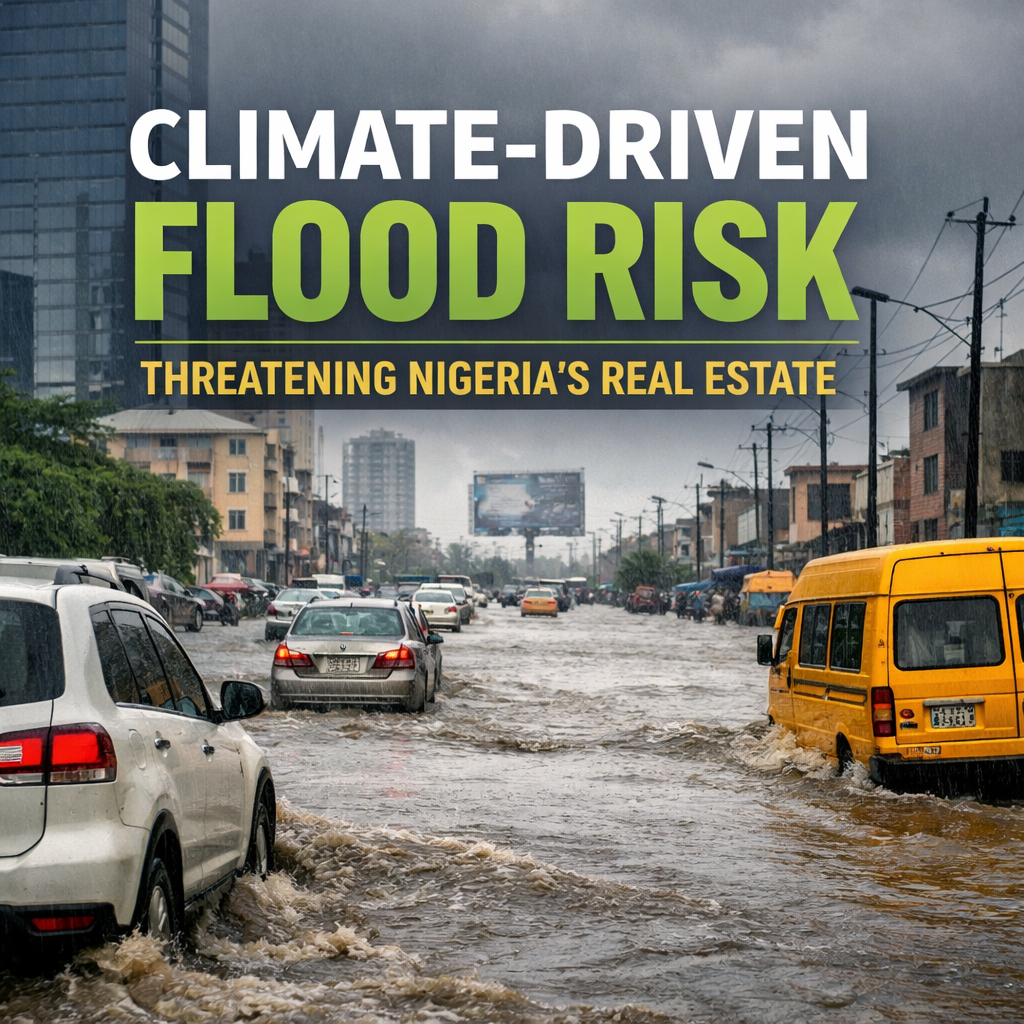
The reality of climate driven flood risk is no longer a future threat. It is already reshaping property markets worldwide. Floods are becoming stronger, more frequent, and more unpredictable. Areas once considered safe are now experiencing severe flooding, forcing real estate investors and developers to rethink assumptions about land value, construction standards, and long-term asset security.
Recent global flood events show that climate change is increasing rainfall intensity and expanding flood zones beyond traditional high-risk areas. In many regions, record-breaking floods have occurred in places previously classified as low risk. This means older flood maps may no longer provide reliable guidance for investment decisions.
For Nigeria, where rapid urban expansion already strains drainage and infrastructure systems, the implications are even more serious.
Nigeria’s Urban Expansion Meets a New Flood Reality
Major Nigerian cities such as Lagos, Port Harcourt, and parts of Abuja already experience seasonal flooding. However, the emerging risk is not limited to river or coastal flooding. Increasingly, cities are facing pluvial flooding flooding caused when intense rainfall overwhelms urban drainage systems.
Unlike river flooding, pluvial flooding can occur far from major water bodies. It happens when paved surfaces prevent water absorption and drainage systems fail to cope with heavy rainfall. Climate change is intensifying rainfall patterns, while rapid and sometimes unregulated urban development increases surface runoff.
Blocked drainage channels, informal construction, land reclamation, and inadequate infrastructure further worsen the problem. As a result, real estate developments built solely on historical flood classifications may face hidden exposure.
For investors, this represents not just environmental risk, but financial risk including property damage, asset devaluation, insurance complications, and long-term market instability.
How Climate Change Is Affecting Property Values in Nigeria
Why Real Estate Investors Must Change Strategy
Climate driven flood risk now demands a shift in real estate strategy.
First, developers must move beyond location-based assumptions. Being outside a historically designated flood zone no longer guarantees safety.
Second, building design standards must evolve. Elevated foundations, improved drainage integration, permeable pavements, retention basins, and flood-resistant materials are increasingly essential, not optional.
Third, due diligence must become more data-driven. Developers and institutional investors should incorporate:
-
Updated rainfall modelling
-
Surface water flow mapping
-
Climate scenario analysis
-
Infrastructure resilience assessments
Ignoring modern flood risk can lead to operational disruptions, rising insurance premiums, reputational damage, and reduced investor confidence.
The Opportunity Within the Risk
Although climate driven flood risk presents serious challenges, it also creates opportunity.
Global capital is increasingly directed toward climate-resilient and sustainable assets. Green infrastructure, climate-smart housing, and resilient urban planning can attract long-term institutional investment.
Developers who integrate sustainable drainage systems, green building principles, and adaptive design will position themselves ahead of regulatory changes and market shifts. Governments and private developers can collaborate to modernize drainage systems, enforce smarter urban planning laws, and prioritize resilience in infrastructure projects. Nigeria has the potential to lead in climate-smart real estate development in Africa if proactive action is taken now.
Conclusion
Climate driven flood risk is fundamentally reshaping how smart real estate markets operate. In Nigeria, the intersection of rapid urban growth and intensifying rainfall makes adaptation urgent.
Developers, investors, and policymakers who respond early can reduce long-term losses, protect property values, and unlock new green investment opportunities. The future of Nigerian real estate will increasingly depend on how well the market understands and responds to climate driven flood risk today.