
Infrastructure-First Housing: A Solution to Nigeria’s Housing Crisis
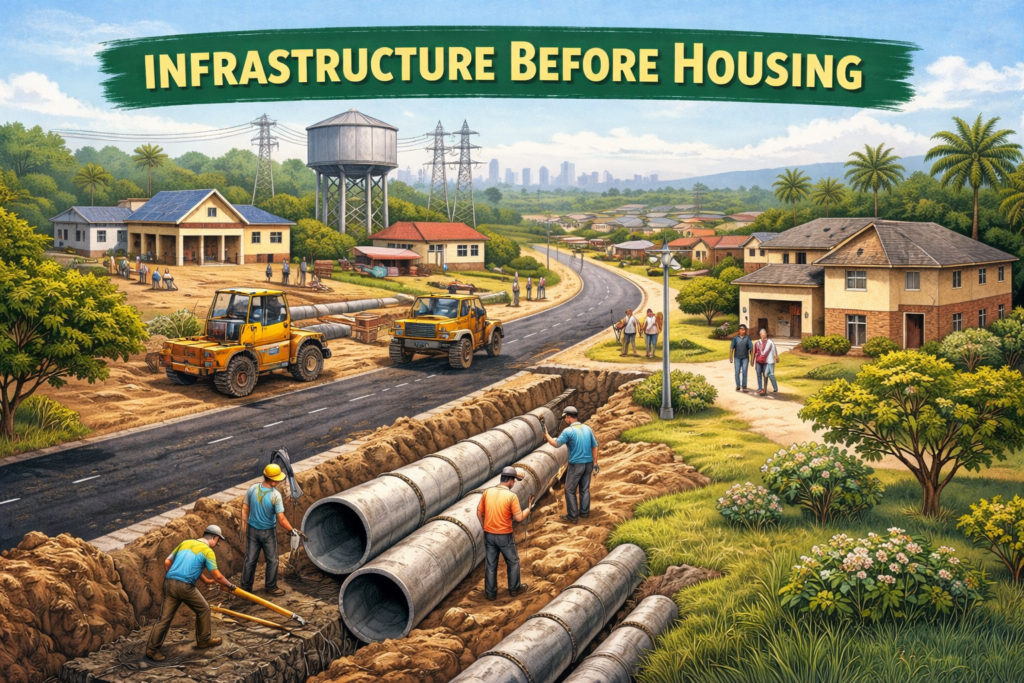
Former Vice President Yemi Osinbajo recently reminded Nigeria of a powerful lesson. In 1959, the Western Region government built Bodija Estate in Ibadan using a simple formula: plan first, build infrastructure next, deliver houses last. Sixty-five years later, that estate still thrives. Speaking at the Wemabod Limited Real Estate Outlook 2026 in Lagos, Osinbajo made the case for returning to deliberate, state-led planning as the pathway to solving Nigeria’s 28 million housing deficit.
The Bodija model wasn’t complicated. It just required commitment to doing things in the right order.
Green Real Estate Investment Boom: Why Nigeria Is the Next Big Opportunity
The Bodija Model: Infrastructure Before Housing
Bodija wasn’t an accident. It was part of a broader regional development program that included free education, civil service expansion, and economic planning. The government anticipated housing demand, planned for it, and shaped it rather than reacting to population pressure. Roads, drainage, water supply, electricity, schools, and community facilities were delivered before anyone moved in. Infrastructure was treated as a public good, not a private burden.
This approach quietly subsidized affordability. Residents didn’t have to self-provide basic services, which reduced their cost of living dramatically. Teachers lived near civil servants. Skilled workers shared streets with professionals. Social integration was designed, not accidental. The estate accommodated modest bungalows for lower-income households, semi-detached units for middle-income earners, and larger homes for senior professionals, all without segregation.
Osinbajo emphasized that Bodija’s planning principles addressed sustainability principles long before climate change became a global priority. Compact, low-rise density, building orientation, tree cover, and proximity to jobs reduced energy demand and flood risk. More than 60 years later, its layout and land values remain resilient.
Why Nigeria Moved Away From This Model
From the late 1980s, fiscal stress, structural adjustment, and rapid urbanization pushed governments out of direct housing delivery. Private developers and public-private partnerships filled the gap. This shift brought investment and innovation but also changed the housing landscape. Many new estates now target narrow income brackets and are often located on urban fringes far from employment centers.
Osinbajo pointed out that infrastructure in many cases has been privatized at the household level. When developers internalize infrastructure costs and capitalize them into house prices, affordability becomes structurally challenging. The fundamental difference between Bodija and contemporary housing delivery is institutional. Bodija benefited from public land assembly, unified planning authority, and socialized infrastructure costs borne by the government.
Osinbajo’s Path Forward
The former vice president proposed a return to state-led planning with properly structured public-private partnerships. Governments should provide land, bulk infrastructure, fast-track approvals, and enforce inclusionary zoning. Private developers bring capital and execution capacity. Inclusionary zoning must be mandatory in large estates to ensure consistent supply of affordable and social housing.
Osinbajo rejected the notion that governments cannot provide housing. He cited Borno State, which built nearly 15,000 housing units in three and a half years despite limited revenue and ongoing security challenges. “It is entirely possible,” he said. “It is a matter of priority and political will.”
Nigeria’s Real Estate Boom: Big Q3 Gains, Tougher Questions Ahead
Conclusion
The Bodija Estate stands as proof that infrastructure-first, socially integrated housing works. It survived 65 years of densification, commercialization, and underinvestment because its foundation was solid. Osinbajo’s message is clear: Nigeria doesn’t need to reinvent housing delivery. We need to remember what worked, adapt it to current realities, and prioritize it. If Borno can build 15,000 homes during a security crisis, imagine what Lagos, Abuja, and other states could achieve with political will. The blueprint already exists. The question is whether Nigeria’s leaders will implement it.