Climate-Proof Real Estate and Nigeria’s Property Future
Climate-proof real estate is no longer just a buzzword. It is quickly becoming a survival strategy.
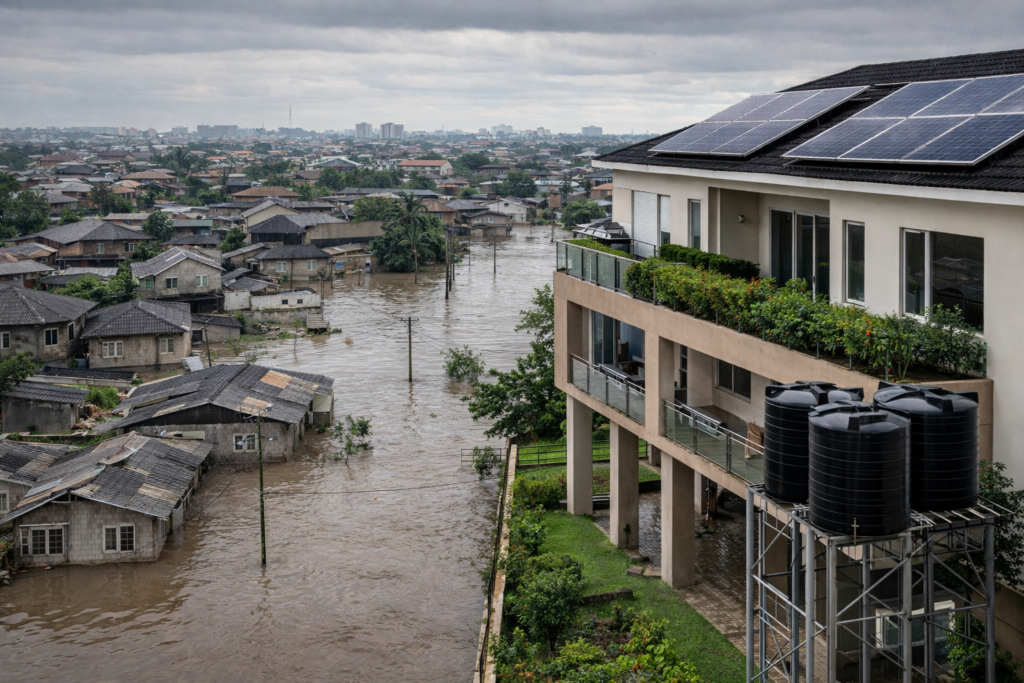
Around the world, climate change is reshaping property markets and Nigeria is not exempt. What used to be considered rare weather events are now recurring disruptions. Floods last longer. Heat waves are harsher. Infrastructure strains under pressure. For property owners and investors, the risks are no longer theoretical.
Nigeria stands at a critical crossroads. If we ignore climate signals today, we risk turning valuable assets into tomorrow’s stranded liabilities.
Globally, analysts warn that many property markets still rely on historical data when pricing homes not forward-looking climate projections. That mismatch creates hidden financial exposure. In some markets, experts suggest climate-related mispricing could significantly erode portfolio value over time. That is not a small oversight. It is a structural vulnerability.
How Climate Change Is Affecting Property Values in Nigeria
Climate-Proof Real Estate and Hidden Financial Risks
First, consider the financial dimension.
In parts of the United States, insurance premiums have risen sharply in flood- and wildfire-prone areas over the past several years. In some states, increases have averaged more than 50% since 2018. As coverage becomes more expensive or unavailable property values begin to feel the pressure. When insuring a home becomes unaffordable, demand weakens. Over time, entire neighborhoods can decline.
Nigeria’s situation is different but potentially more fragile. Insurance penetration remains low, meaning many homeowners absorb repair costs directly after disasters. In cities such as Lagos and Port Harcourt, flooding is no longer an occasional inconvenience; it is a recurring reality. Yet developments continue to rise in vulnerable zones, often without serious drainage planning or flood-risk assessment.
In effect, we may be constructing future financial losses today.
Without integrating climate risk into valuation, investors face the possibility of sudden asset devaluation not because the building is poorly designed, but because the environment around it has fundamentally changed.
Climate-Proof Real Estate and Nigeria’s Urban Expansion
Nigeria’s rapid urban growth adds another layer of complexity.
Millions migrate into cities every year in search of opportunity. Housing demand rises. Construction accelerates. But expansion without environmental foresight increases exposure to flood plains, heat stress zones, and poorly drained land.
Communities with limited infrastructure suffer first and hardest. Flooding disrupts livelihoods. Heat waves increase energy demand. Public health risks rise.
Regulatory signals are also shifting. In recent years, authorities in Lagos have sealed properties that failed to meet environmental and planning requirements. The message is clear: climate compliance is moving from optional to mandatory.
At the same time, global markets show a strong trend toward green-certified buildings. In some regions, sustainable developments are projected to dominate new supply within the next few years. These properties often reduce energy costs substantially and can command value premiums. Sustainability is no longer about image, it is about operational efficiency and risk management.
Climate-Proof Real Estate Through Adaptation and Innovation
The path forward for Nigeria is not abstract. It is practical. Infrastructure must be rethought with resilience in mind. Some countries, including Australia, are investing in “sponge city” concepts that integrate rooftop gardens, improved drainage systems, and permeable surfaces to manage excess rainfall. While Nigeria’s context is different, the principle is adaptable: build with water, not against it.
Developers should integrate climate-risk assessments at the feasibility stage of every project. Banks can require environmental disclosure before financing. Investors should evaluate exposure to flood zones, infrastructure reliability, and long-term climate projections before committing capital.
These steps are not radical. They are responsible.
Enugu Real Estate Takes Off with Aviation Boom
Conclusion
Climate-proof real estate is not optional for Nigeria. It is foundational to financial stability, public health, and long-term urban resilience.
If climate risk continues to be ignored in property decisions, asset values may shrink and social costs will rise. But if developers, regulators, financiers, and homeowners act decisively, Nigeria can turn climate exposure into opportunity. The future of Nigeria’s property market will not be decided by location alone. It will be decided by resilience. And those who build with foresight today are the ones most likely to thrive tomorrow.