Lekki Palm Estate Demolition: The Hard Truth About Lagos’ Urban Development
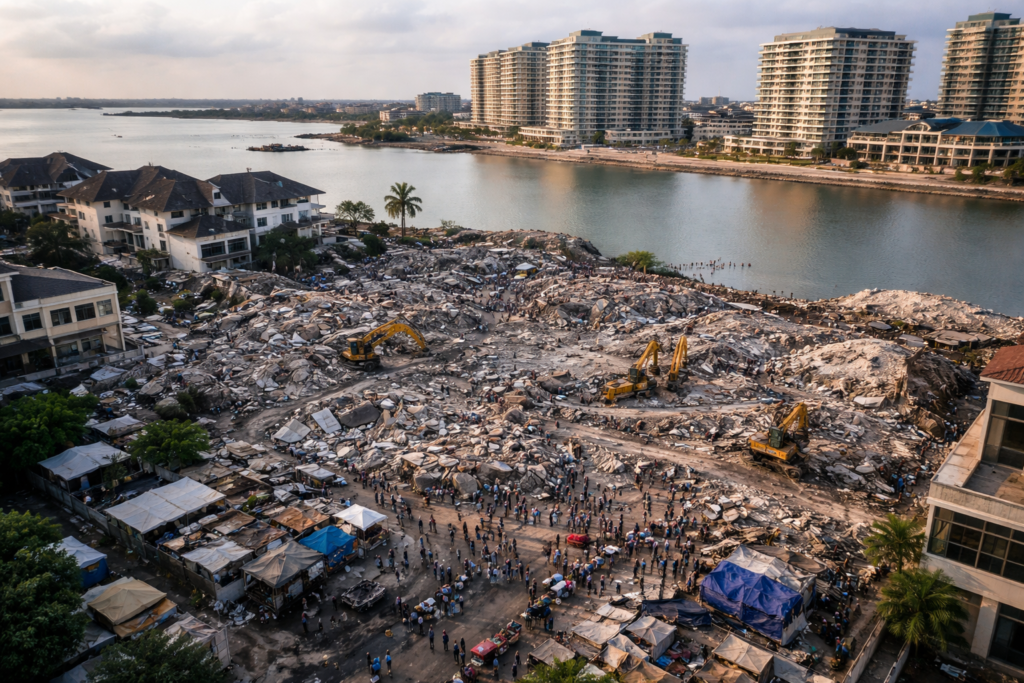
The Lagos government demolished Lekki Palm (Palm City) Estate, showing that investing large sums in real estate does not automatically guarantee safety. For once, it was not poor or informal communities being cleared for luxury development, but high-value residential homes demolished over alleged building and planning violations. This stands in sharp contrast to past demolitions such as Makoko, raising uncomfortable questions about enforcement and fairness.
Demolishing Homes While Luxury Rises on Water
Palm City Estate in Ajah did not fall simply because Lagos suddenly became concerned about safety. That explanation feels incomplete. Authorities pulled down homes, displaced families, and disrupted livelihoods in the name of planning laws. Yet only a few kilometres away, luxury estates continue to rise boldly on reclaimed land, sand-filled wetlands, and fragile lagoon edges. The same water. The same environmental risk. Different outcomes for different people.
Palm City Was a Real Community
Palm City was not a slum. It was a settled residential community. People legally bought land, built homes, and moved in their families. Teachers, traders, civil servants, and young professionals lived there. Many invested their life savings in homeownership because renting in Lagos has become increasingly punitive. Then one morning, bulldozers arrived. There was little dialogue, no gradual resolution—just demolition.
Planning Laws for Some, Profit for Others
The official explanation remains familiar: lack of approvals, safety concerns, planning violations. However, this narrative becomes difficult to sustain when viewed alongside ongoing developments across the Lekki–Ajah corridor. While Palm City homes were crushed, large luxury estates worth billions of naira continue extensive sand-filling of wetlands and lagoon-adjacent land. These estates are gated, guarded, and marketed to the wealthy. They are rarely labelled unsafe, and enforcement actions there appear minimal or absent.
https://www.greenrealtyafrica.com/makoko-demolition-the-part-nobody-is-talking-about/
Flood Risk, Climate Blindness, and Bad Urban Math’s
There is also an environmental cost Lagos seems unwilling to confront honestly. Authorities displaced hundreds, possibly thousands, from Palm City, while developers cater new estates to only a tiny fraction of Nigerians, even as the country faces a housing deficit of about 28 million homes.. Sand-filling wetlands worsens flood risk by disrupting natural drainage systems. Environmental activist Nnimmo Bassey has repeatedly warned that reclaiming land in flood-prone Lagos deepens the climate crisis. Water does not disappear; it always finds its way back.
Who Lagos Development Really Serves
Former minister Oby Ezekwesili once observed that Nigeria’s political class often protects elite interests while ordinary citizens bear the consequences. The Palm City demolition reflects this troubling reality. Authorities destroy existing homes in the name of regulation, while developers continue environmentally risky luxury projects unhindered. Development that displaces many to protect the comfort and profit of a few cannot reasonably be described as progress.
Conclusion
The demolition of Lekki Palm Estate exposes deeper inconsistencies in Lagos’ urban development approach. When middle-class communities are demolished for planning violations while luxury estates rise on fragile wetlands, enforcement begins to appear selective rather than purely regulatory. Beyond the human cost, this inconsistency undermines trust in the real estate market and increases long-term environmental risk. Sustainable development in Lagos must be guided by fairness, transparency, and environmental responsibility not profit alone.
https://app.yusocial.com/blogs/616/Niger-Flooding-Real-Estate-Crisis-Lives-Lost-Futures-Drowned
Should Lagos enforce planning laws equally for all communities? Comment below