
1.5% of climate finance. 100% of our children’s future.
Every investor knows that a building is only as strong as the ground it stands on. Nigeria’s schools stand on shaky ground, and a new report says our children are paying for it. The Institute for Greening Education in Nigeria (IGEN) has revealed that the country ranks second out of 163 nations for children’s exposure to climate and environmental risks.
The Funding Gap Is the Real Story
The risks are familiar: flooding, extreme heat, erosion, drought and desertification. They’re damaging school buildings, interrupting lessons and putting pupils and teachers at risk.
The money tells a harder story. Education receives only about 1.5 per cent of global climate finance. IGEN’s Executive Secretary, Unyime Robinson, said at the launch of the State of Green Education in Nigeria Report in Abuja that most climate funding goes to infrastructure, with little left for green school program teacher training and climate education.
He wants education written into Nigeria’s Nationally Determined Contributions, so the sector can access both domestic and international climate finance. If it isn’t in the plan, it won’t get the funding.
Why Climate Financing Is Quietly Reshaping Nigeria Real Estate
What the Report Recommends
The report names four obstacles: unclear policy direction, weak coordination between institutions, limited teacher capacity and too little financing. And the proposed fixes for the obstacles include:
- A National Policy on Greening Education
- A national coordination mechanism
- Green and climate-ready school standards
- A National Green Schools Index and Certification Scheme
- A digital portal to track implementation
Robinson was clear that teaching children about climate change isn’t enough. Sustainability has to shape how schools are run, how teachers teach and how institutions are managed. To its credit, the Federal Government has already set up a Greening Schools and Climate Change Education Intervention under the Universal Basic Education Commission, with a two per cent matching grant to help states. That’s a solid foundation to build on.
Why Real Estate Should Pay Attention
Schools are real estate. Every classroom is a physical asset exposed to flood, heat and erosion, and the same risks that threaten a school threaten the homes and businesses around it. A community with climate-ready schools is a more stable, more valuable place to build.
Greening education is also an economic strategy. IGEN says it prepares young Nigerians for jobs in renewable energy, sustainable agriculture, waste management and green construction. For developers, that means a future workforce with exactly the skills our industry will need.
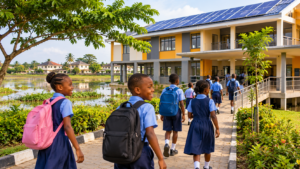
My advice to developers and investors is simple. Build schools with flood-resilient design, natural cooling and solar power. Partner with state governments and education bodies where you can. The returns show up in safer children, stronger communities and better property values.
Nigeria can’t afford to leave its children this exposed. Protecting them is the best long-term investment we can make.
Nigeria ranks second globally in children’s climate risk