
Affordable Housing in Nigeria Must Evolve—Climate Change Is Forcing a Rethink
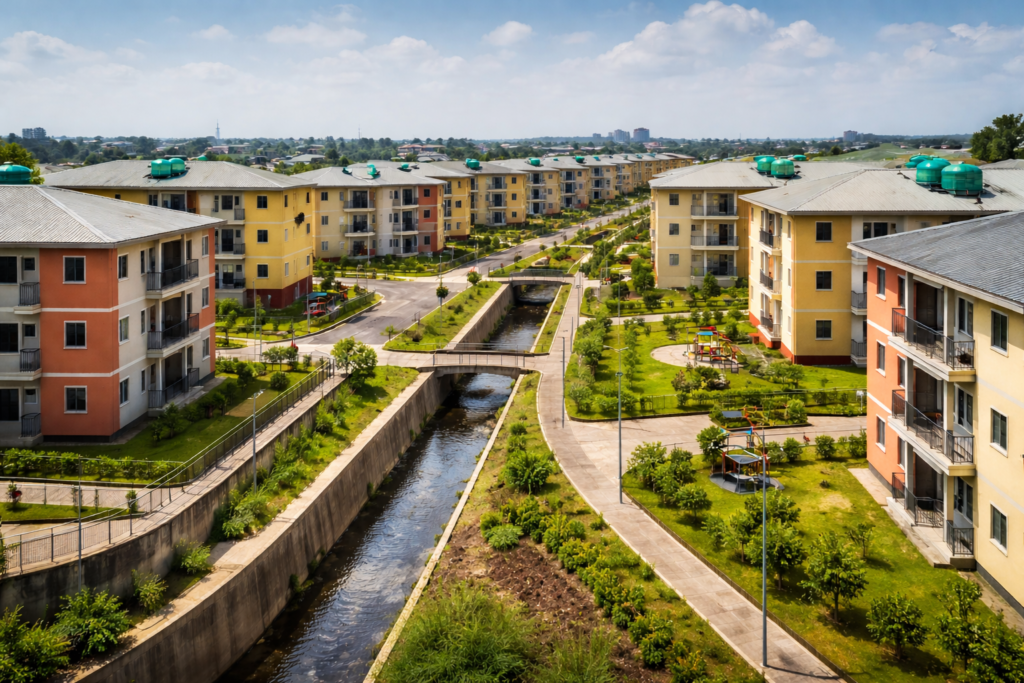
Affordable housing in Nigeria is often framed in numbers millions of units required, rapid urban population growth, and rising construction costs. However, focusing only on quantity misses a deeper and more urgent issue: the growing impact of climate change on housing.
Affordable housing in Nigeria can no longer be developed without considering environmental realities. As climate risks intensify, the question is no longer just how many homes are built, but how well they can withstand the conditions they are built into.
Affordable Housing in Nigeria and Climate Change
The Hidden Risks in Current Housing Models.
Across many Nigerian cities, housing developments continue to follow traditional models that were never designed for today’s environmental pressures. Flooding, extreme heat, and poor drainage systems are no longer isolated incidents they are becoming recurring challenges.
The impact is most severe in low-income communities, where housing is often built with limited planning and minimal infrastructure. In these areas, poorly designed developments do more than fail to solve the housing deficit, they actively increase vulnerability.
As a result, what is labeled as “affordable housing” can quickly become costly in terms of repairs, health risks, and long-term sustainability.
Why Climate-Resilient Housing Matters
Climate-resilient housing is not just about stronger buildings, it is about smarter development. It considers where homes are built, how they are constructed, and how they function over time.
This approach involves careful site selection to avoid high-risk areas, the use of materials that can withstand environmental stress, and the integration of systems that reduce energy and water consumption. When properly implemented, these measures do not just protect homes they improve living standards and reduce long-term costs for residents.
While the upfront investment may be higher, the long-term benefits are clear. Lower maintenance costs, improved durability, and greater resilience make climate-smart housing a more sustainable solution.
The Role of Smart Urban Planning
Affordable housing cannot be separated from urban planning. The location and layout of developments play a critical role in their long-term viability.
Cities must move toward integrated planning that connects housing with infrastructure, transportation, and environmental management. Without this coordination, even well-constructed homes can become unsustainable due to poor access, flooding risks, or inadequate services.
Smart urban planning ensures that housing developments are not just built quickly, but built to function effectively within a growing city.
Diaspora Property Wealth Nigeria: How Nigerians Abroad Invest Right
What Is Holding Progress Back
Despite the urgency of the issue, progress remains slow. Funding constraints continue to limit the ability of developers to invest in more resilient designs. At the same time, many projects prioritize short-term affordability over long-term sustainability.
Regulatory challenges also play a role. Weak enforcement of building standards allows substandard developments to persist, while the absence of strong incentives discourages innovation in sustainable housing.
Bridging this gap will require a shift in both policy and mindset. Developers, regulators, and investors must begin to see resilience not as an added cost, but as a necessary component of modern housing.
Conclusion
Nigeria’s housing challenge is no longer just about building more homes, it is about building better ones.
Affordable housing must evolve to reflect the realities of climate change. As environmental pressures continue to grow, the resilience of housing will become just as important as its accessibility.
The future of Nigerian cities will depend on how quickly this shift is embraced. Those who prioritize smarter, more sustainable housing today will help shape a more stable and livable urban future.