
Nigeria’s Land Tenure Problem Is the Real Estate Crisis Nobody Is Talking About
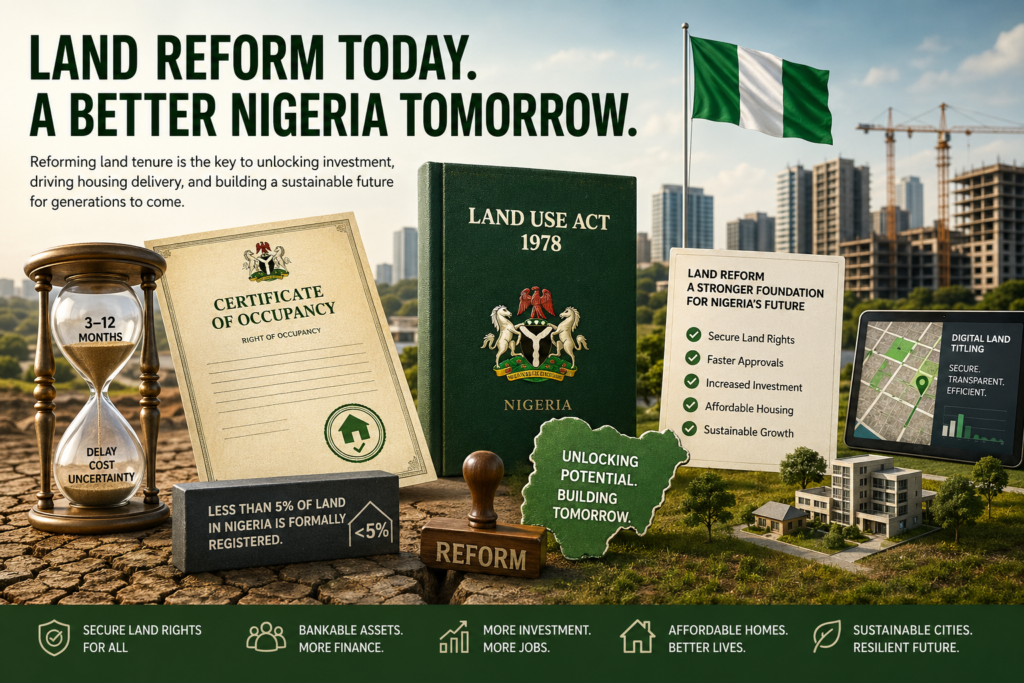
Nigeria land tenure reform is one of the most urgent conversations the real estate sector is not having. Less than 5 percent of land in Nigeria is formally registered. That is not a minor administrative gap. That is the foundation of why housing finance remains shallow, why developers face impossible delays, and why international capital keeps hesitating at the door.
Why Land Tenure Reform Nigeria Cannot Wait
A military administration enacted the Land Use Act in 1978. It vests all land in every state in the hands of the Governor, meaning no individual or business in Nigeria can own land outright. What exists instead is a right of occupancy, a government-issued permission that can, in theory, be revoked. Nobody has meaningfully reformed the law since it was written. Nigeria’s real estate market, its financing systems, and its urban development ambitions have all changed dramatically in 48 years. The legal framework has not moved with them.
The most visible consequence is the Certificate of Occupancy process. Before a developer can build, before a buyer can access mortgage financing, before an investor can commit capital, the developer must establish legal title through the state government. According to a PwC report, this process takes between three and twelve months in Nigeria and is ranked among the most cumbersome in Africa. Files go missing. Fees multiply. Approval timelines stretch beyond any reasonable project schedule. Every day spent waiting is a day the market stands still.
The Cost Nobody Puts in the Budget
Developers understand this reality even if they do not always say it openly. The cost of navigating land administration in Nigeria does not appear as a line item in most project budgets, but it shows up everywhere.Developers price it into their margins. Buyers absorb it through higher purchase prices. Those trying to access formal housing finance feel it most acutely, because Nigerian banks will not lend against a property without a perfected title, because Nigerian banks will not lend against a property without a perfected title. That single bottleneck effectively excludes millions of Nigerians from the mortgage system entirely.
The Federal Government has begun to respond. The Federal Government inaugurated Land Reform Task Teams in late 2025. There are proposals for a National Land Commission that would standardise land administration across all 36 states. The Land4Growth programme is rolling out digital land titling across states, and the government has identified over ₦300 billion in dormant land assets it wants to unlock for housing delivery. These are encouraging signals. But the reform conversation has been circling for decades. Under Yar’Adua, a land modernisation programme stalled before implementation. Under Jonathan, a land audit effort failed to address the deeper structural issues. The announcements keep coming. The execution rarely follows.
ESG-Driven Real Estate Transformation Is Redefining Nigeria’s Property Market
Why It Matters More Now Than Before
What is different in 2026 is the external pressure. Nigeria is actively courting ESG-linked capital, green bonds, and international climate finance for its real estate sector. That capital does not flow into markets where legal ownership of land cannot be quickly verified. Sophisticated investors deploying sustainability-linked funds need more than green credentials from developers. They need bankable, digitally verifiable, legally certain assets. Right now, with less than 5 percent of Nigerian land formally titled, the sector cannot fully offer that.
The housing deficit, the affordability crisis, the mortgage gap all of these are real problems that deserve real attention. But without land tenure reform that actually reaches implementation, every solution built on top of it remains unstable. The foundation has to be fixed first.
Conclusion
Nigeria’s real estate sector is in transition. New policies, new financing structures, and stakeholders are introducing stakeholders are introducing new sustainability standards at the same time. But the land tenure system remains the quiet variable that determines whether all of it works. Reforming the Land Use Act is not a technical detail for lawyers and surveyors to debate. It is the single most important step Nigeria can take to unlock its real estate potential. The question in 2026 is not whether the reform is needed. Everyone agrees it is. The question is whether the political will to see it through will finally match the scale of the problem.