
Cement Now Costs ₦15,000 a Bag. Nigeria’s Housing Crisis Just Got a New Enemy.
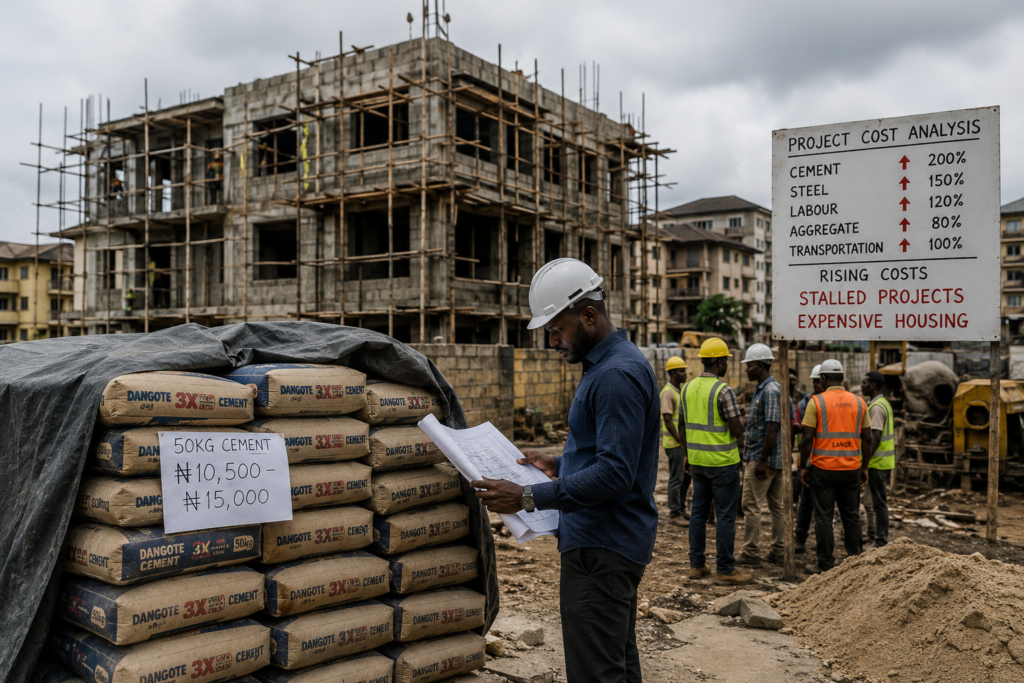
Cement prices in Nigeria are hitting housing harder than anything else right now. A 50kg bag now costs between ₦10,500 and ₦15,000, nearly double what it sold for not long ago. And nobody building anything in this country, roads, houses, offices, bridges has been spared.
The Federal Government has had enough.
On Sunday June 22, Minister of Works Senator David Umahi issued a direct public warning to cement manufacturers at the unveiling of HBM formerly Lafarge Africa in Lagos. His message was blunt: reduce your prices immediately, or the government will make life very uncomfortable from July 1.
What Umahi Actually Said
The minister did not mince his words at the Lagos Continental Hotel event.
Contractors handling federal infrastructure projects have been demanding upward revisions of contract sums because of rising cement costs. Umahi’s response to that pressure is telling he refused to approve contract variations and pointed the finger squarely at the manufacturers instead.
The Federal Government will begin formal engagements with cement producers from July 1. That conversation is not optional. Umahi made clear that neither the government’s infrastructure budget nor individual contractors should bear the cost of what he sees as unjustified price escalation by manufacturers.
He stood before industry leaders, investors, and stakeholders at a major corporate event. He made it impossible for the cement industry to claim ignorance. He also urged HBM and other cement producers to expand production capacity to meet the growing demand generated by the government’s nationwide infrastructure drive. The logic is simple: if supply keeps pace with demand, pricing pressure eases. Right now, supply is not keeping pace and manufacturers appear to be taking advantage of that gap.
Why This Matters for Housing
Cement is not just an infrastructure input. It is the single most important building material in Nigeria’s housing supply chain.
When cement prices double, construction costs follow. When construction costs rise sharply, developers face a choice, absorb the loss, pass it on to buyers, or halt the project. Most choose the latter two. In a market already struggling with a housing deficit that exceeds 22 million units, both outcomes make an already difficult situation worse.
Cement prices keep rising for several reasons. Strong demand, high fuel costs, and rising transportation expenses are all pushing the number up. Persistent inflationary pressures add even more weight. Aliyu Oroji, immediate past president of the Real Estate Developers Association of Nigeria, said rising building costs slow construction and push property prices beyond the reach of average citizens.
That observation cuts to the heart of what is happening. Nigeria needs hundreds of thousands of new homes built every year just to keep pace with population growth and urbanisation. Every cost shock that hits the construction sector slows that pipeline. The people most affected are not luxury buyers in Ikoyi or Maitama they are middle and low income Nigerians trying to access decent housing in cities that already fail to supply enough of it.
Empty Houses, Rising Rents: The Paradox of Lagos Real Estate
The Lafarge-HBM Angle
The timing of the minister’s intervention is also worth noting.
Umahi chose the unveiling of HBM Lafarge Africa rebranded following its acquisition by Chinese-based HUAXIN Group as the moment to issue his warning. That setting was deliberate.
The rebranding of Lafarge to HBM represents a significant ownership shift in Nigeria’s cement sector. HUAXIN Group’s entry brings new capital, new production ambitions, and potentially new pricing dynamics. Umahi used the occasion to signal clearly that the government expects new capacity to come with lower prices not higher ones.
What Developers and Buyers Should Watch
July 1 is the date to track. That is when the Federal Government says formal engagement with cement manufacturers begins.
Whether those engagements produce actual price reductions or simply generate more press releases is an open question. Nigeria has seen similar interventions before public pressure on commodity producers that generates headlines without fundamentally changing prices at the point of sale.
What is different this time is the scale of the problem and the directness of the government’s position. Refusing to approve contract variations is a significant pressure point. It tells manufacturers that if prices stay high, contractors will not be made whole by the government and that creates its own chain of consequences for project pipelines and payment cycles across the construction sector.
Every project currently in planning needs updated cost models. Last year’s benchmarks no longer hold. Anyone still building on pre-2025 cost assumptions is heading toward a shortfall they will not see coming until it is too late.
For buyers, higher cement costs mean homes under construction today will cost more to complete. Developers will push that cost into selling prices and rental rates one way or another.
Conclusion
Nigeria’s housing deficit does not shrink when construction becomes more expensive. It grows. A 50kg bag of cement at ₦15,000 is not a minor supply chain fluctuation it is a structural cost shock that slows housing delivery at precisely the moment the country needs it to accelerate.
Umahi’s intervention is the right call. Whether the cement manufacturers respond before July 1, or whether the government has to follow through on its pressure, will determine how much of the 2026 construction pipeline survives intact.
Nigeria’s Housing Crisis Has Reached Port Harcourt. The Numbers Are Alarming.
FOCUS KEYPHRASE
cement prices Nigeria housing
SEO TITLE (58 characters)
Cement Prices Nigeria Housing: The ₦15,000 Bag Problem
SLUG
cement-prices-nigeria-housing-umahi-manufacturers
META DESCRIPTION (153 characters)
Cement now costs ₦15,000 a bag in Nigeria. Minister Umahi has warned manufacturers to cut prices by July 1. Here is what it means for housing and real estate.