
London Climate Action Week Is Asking the Biggest Question in Climate Finance. Nigeria and Lagos Are in the Room.
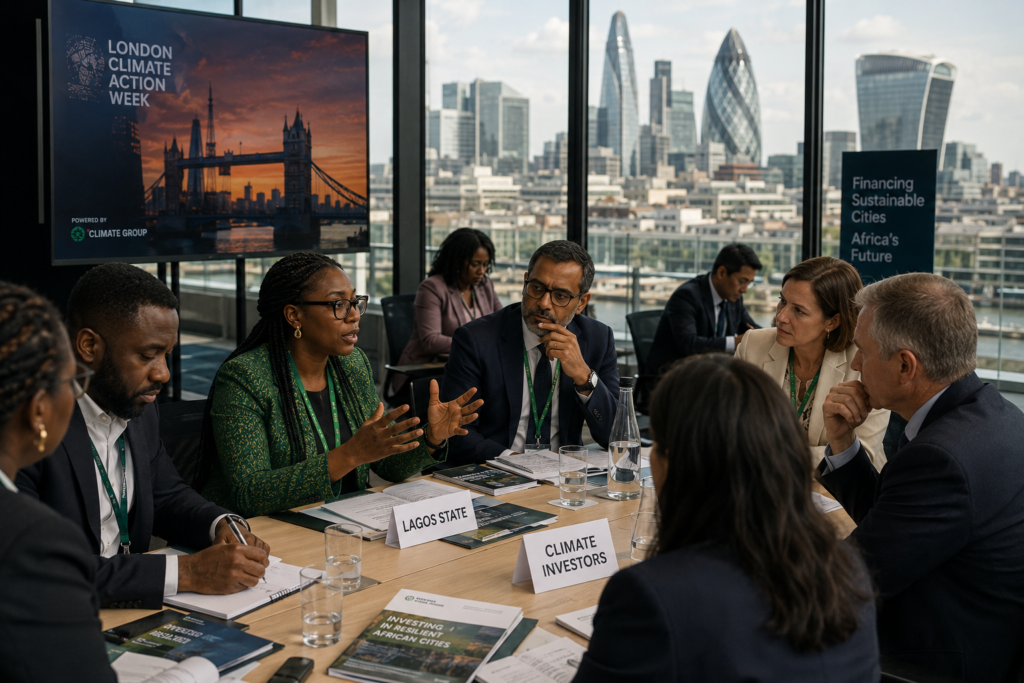
London Climate Action Week 2026 is happening right now and for once, Nigeria and Lagos are not watching from the sidelines.
Not a press release. Not another commitment document. An actual gathering the kind where the people who control climate capital sit across the table from the people who need it, and the conversation gets real.
London Climate Action Week is now in its eighth year and has grown into Europe’s largest city-wide climate gathering, pulling in nearly 50,000 participants across more than 700 events. Heads of state. Central bank governors. Institutional investors. Development finance institutions. City leaders. All of them are in the same city this week, talking about one thing above everything else: money. Where it is. Where it needs to go. And why it keeps falling short.
For Nigeria, that conversation is not abstract. It is urgent.
What London Climate Action Week Is Actually Discussing
The theme this year is “Climate Cooperation in a Fractured World,” focusing on how governments, businesses, investors, and citizens can continue to build the partnerships and practical solutions needed to drive climate action forward.
Strip the diplomatic language away, however, and the real question is simpler. Who is going to pay for all of this? And how do you get that money to the places that need it most?
Climate impacts are accelerating, yet finance for resilience still falls far short of what is needed. At the same time, regulators, investors, and insurers are increasingly recognising that climate risk is financial risk and that realisation is starting to create new investment opportunities.
The UNEP Finance Initiative Global Roundtable running alongside LCAW carries the theme “From Risk to Resilience: Financing the Future” exploring how financial institutions can help mobilise investment, strengthen resilience, and support sustainable growth.
Nigeria should pay close attention to every word of that.
Lagos Showed Up and Not Empty-Handed
Here is the part of this story that deserves more attention than it has received.
The Lagos State Government has partnered Climate Action, a leading international climate organisation, to strengthen sustainable finance and accelerate climate implementation as part of activities at London Climate Action Week 2026. Facilitated through the Office of Climate Change and Circular Economy, the partnership focuses on innovative climate finance solutions. The goal is supporting the transition to resilient, low-carbon economies across Africa and the Global South.
Governor Babajide Sanwo-Olu is leading the state’s delegation to the Local Climate Action Summit hosted by Bloomberg Philanthropies at Guildhall the flagship gathering for subnational governments during LCAW, bringing together governors, premiers, ministers, and regional leaders ahead of COP31.
Beyond attending panels, the Office of Climate Change and Circular Economy is hosting its own private executive roundtable titled “Financing State-Determined Contributions: Connecting Climate Capital to Africa’s Most Investment-Ready Cities” bringing together investors, climate funds, development finance institutions, and technical partners to explore how to mobilise funding for Lagos’s climate priorities.
That is a different posture from what Nigeria usually brings to international climate gatherings. Lagos is not presenting itself as a country waiting for help. Instead, it is presenting itself as a city ready for investment.
Whether that posture translates into actual capital flowing home is the real test. But the positioning is the right one.
Nigeria’s Climate Targets Are Ambitious. The Solutions Have to Come From Here.
The Money Problem Nobody Is Solving Fast Enough
Here is the uncomfortable reality sitting beneath all the roundtables and summits.
At COP30, the global climate finance target was set at $1.3 trillion yearly by 2035, with adaptation finance tripled. That sounds like progress. Until you look at the track record.
Africa starts 2026 with climate ambition firmly on paper but uncertain implementation. The scale, predictability, and accessibility of climate finance remain unreachable for most African countries, while private capital mobilisation stays risk-averse and largely absent.
Nigeria knows this directly. The country needs $337 billion to implement its NDC commitments, and eighty percent of that depends on international finance. That international finance, however, has a long history of arriving late, arriving in the wrong form, or not arriving at all.
Across the continent, Africa faces a $1.4 trillion financing gap for affordable housing alone. Although green homes can reduce electricity and water bills over time, their higher upfront costs make them unaffordable for most people. Very few green housing financing opportunities currently exist for developers and homeowners.
That gap does not close by itself. It closes when the structures, instruments, and accountability mechanisms that LCAW is discussing this week actually get built and when African cities are positioned to absorb the capital when it finally moves.
Where Real Estate Fits
Buildings matter more in this conversation than most Nigerian developers realise.
UNEP is using LCAW 2026 to elevate action on decarbonising buildings and construction, and on mobilising finance to support climate action at scale. Beyond that, London is also hosting a Built World Summit and the World Green Buildings Council Solutions Forum because the built environment is one of the sectors where climate finance can move fastest and have the most visible impact.
Green bonds for building retrofits. Blended finance for affordable sustainable housing. Climate risk disclosure standards for property assets. These are not conversations about the future they are happening in London right now.
Nigeria’s real estate sector is not yet structurally connected to any of them. Most developers are still navigating financing environments that have nothing to do with sustainability. But the direction is clear, and the window to position within these emerging climate finance frameworks does not stay open indefinitely.
What Should Happen When the Delegation Returns
Lagos’s Commissioner for Climate Change said it plainly before the delegation left: climate leadership is no longer measured by commitments alone. Through the State-Determined Contributions framework, Lagos is building a transparent and scalable model capable of unlocking capital and accelerating climate implementation across Africa and the Global South.
That language scalable, transparent, investment-ready is exactly what climate financiers in London want to hear. Lagos spoke it fluently this week.
The harder question, though, is what happens after June 28. Whether the relationships built in London become funding lines in Lagos. Whether the roundtables become projects. Whether the conversations about connecting climate capital to African cities show up as real investable opportunities for Nigerian developers and communities or simply fade into the archive like so many promising announcements before them.
Conclusion
Nigeria’s Central Bank Governor Olayemi Cardoso has already said it directly: “Climate risk is financial risk.” London Climate Action Week is where that idea gets turned into capital flows. Nigeria needs to keep showing up and coming back with something concrete every time.