
Coastlines are only worth what their protection is worth.
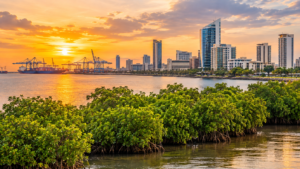
Coastlines are real estate’s most valuable and most exposed frontier. So when a new World Resources Institute (WRI) analysis shows that more than 95 per cent of recent climate plans from coastal and island countries include ocean measures, property investors should pay attention. The plans are written. The question is who will pay to carry them out.
The Commitments Are Up. The Capacity Isn’t.
WRI’s report, Ocean-Based Climate Action in 2025 NDCs, shows how far ocean action has come. Ocean-related commitments in national climate plans rose from 62 per cent in 2015 to 73 per cent in 2022, and now exceed 95 per cent.
The catch is delivery. Of the 1,281 ocean commitments analyzed, 61 per cent are conditional or partly conditional, .meaning countries can’t deliver them with existing financial, technical and institutional resources. Every commitment from low-income countries falls into that group, compared with 35 per cent for high-income countries. Governments need help with finance, data, technology, expertise and coordination, and the report stresses that this goes beyond project funding to include policy reform and stronger public institutions.
The prize is large. Citing the High-Level Panel for a Sustainable Ocean Economy, WRI notes that ocean-based solutions could deliver up to 35 per cent of the annual emissions cuts needed by 2050.
Why Climate Financing Is Quietly Reshaping Nigeria Real Estate
Africa’s Focus Is Protecting People and Livelihoods
Across the report, adaptation makes up almost 70 per cent of ocean commitments. In sub-Saharan Africa the share is about 85 per cent, with fisheries and coastal zone management leading the list. That means mangrove and wetland restoration, coastal protection, flood response and defence against saltwater intrusion into groundwater, plus resilient ports to protect trade from rising seas and extreme weather.
This should sound familiar in Nigeria. Our Atlantic coast, and Lagos in particular, faces flooding and erosion, and our recent NDC 3.0 puts $141.5 billion towards adaptation over the next decade. The gap between that ambition and available funding is exactly the problem WRI describes.
What Real Estate Should Do
Coastal land is only worth what its protection is worth. Before you buy or build, assess flood, erosion and groundwater risk, and favor developments that restore natural buffers like mangroves and wetlands. Watch where adaptation money flows, because ports, drainage and coastal defenses are where public and private capital will meet.
The report points to COP31’s Climate Implementation Bridge as one way to link national plans with project preparation and financiers. Developers and investors who understand it early will find the opportunities first.
The plans are in. The coastlines are waiting.