
Build schools that stay open through floods and heatwaves.
Nigeria Wants Climate-Resilient Schools. Here Is What That Means for Builders and Investors
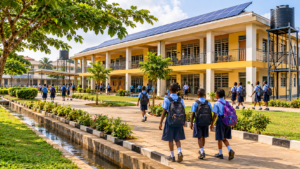
School buildings should be the safest places a child spends the day. Too often, though, they fail first in a flood or become unbearable in a heatwave. That is why a call from the Universal Basic Education Commission (UBEC) matters well beyond education. At a workshop in Kano, UBEC urged state governments to adopt climate-resilient designs for public schools. The aim is to guard against flooding, erosion, extreme heat, and water scarcity.
What UBEC Is Asking For
Dr Aisha Garba, UBEC’s Executive Secretary, set out the basics. School buildings must offer ventilation, thermal comfort, and energy efficiency. They must also be accessible to all learners. The Federal Government has revised the minimum standards for basic education infrastructure. As a result, planning, design, construction, supervision, and maintenance will follow the same guidelines nationwide. The review followed persistent problems. These include unsafe classrooms, poor sanitation, and weak accessibility.
Several partners helped develop the standards, including the Federal Ministry of Education, UNICEF, the World Bank, and professional bodies. UBEC expects better implementation to improve compliance, strengthen accountability, and reduce substandard construction. In addition, Kano’s state education board made a request. It wants to use part of the two percent monitoring funds to train technical officers. After all, inspectors can only enforce what they know how to spot.
Clean energy powers buildings. Not promises.
This Is Already Working
There is proof that this approach works. A UK-funded program with UNICEF assessed and strengthened 45 schools and 39 health centers in Kano and Jigawa. It has since expanded to Bauchi, Enugu, Gombe, Kaduna, and Katsina.
What It Means for the Property Industry
Standards create demand. Architects, engineers, and contractors who understand the new guidelines will win more public projects. The same thinking applies to estates, clinics, and commercial buildings. Therefore, developers should treat school standards as a preview. Private building codes and lender expectations may follow the same direction.
First, document your design choices. Second, track how your buildings perform. Finally, be ready to show the results. A building that protects its occupants is a better asset. As a result, it is easier to finance, insure, and sell.
Here is my take; I see this as a quality issue as much as a climate one. Resilient design does not have to be expensive. For example, raised floors and good drainage keep floodwater out. Deep eaves, shaded windows, cross-ventilation, and reflective roofs keep classrooms cooler without relying on unreliable power. Rainwater harvesting and solar also help close water and energy gaps.
The real risk is cost-cutting during construction. That is why monitoring and trained inspectors matter as much as the design itself. Over its life, a school that floods or overheats costs far more than one built properly the first time.