
Nigeria’s Construction Industry Needs a Workforce Strategy. Nobody Is Building One.
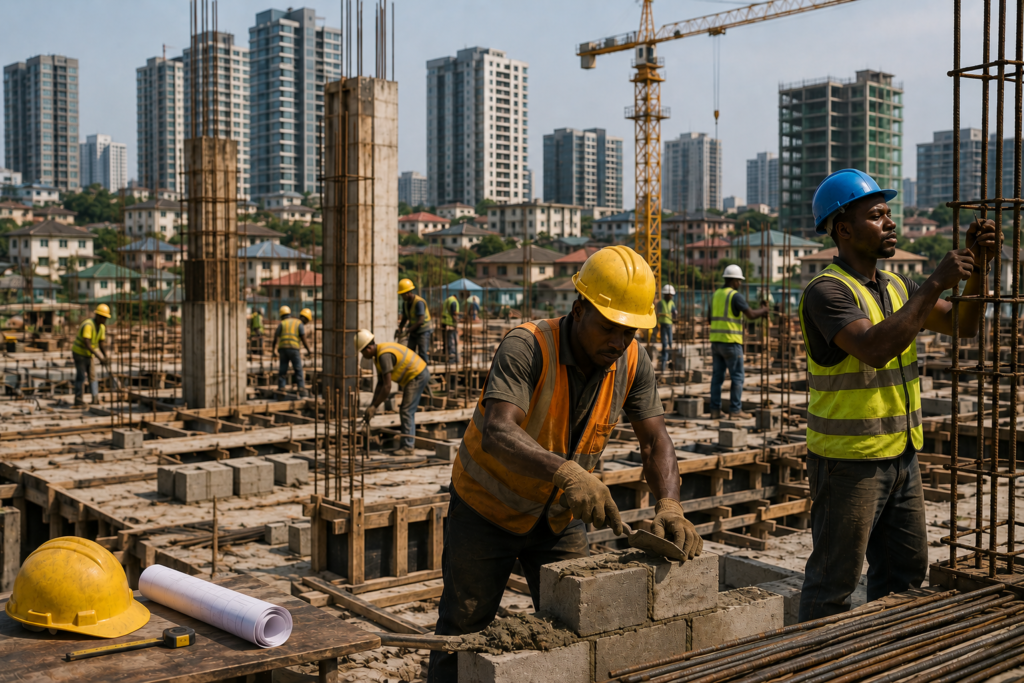
There is a crisis playing out on Nigerian construction sites that does not make headlines the way building collapses do. It is quieter. It is quieter and slower. And in the long run, it may be more damaging to the sector than any single structural failure.
Nigeria is losing its construction workforce. And nobody is building a plan to replace it.
The People Are Leaving
Walk into any serious construction project in Lagos, Abuja, or Port Harcourt today and ask the site manager about his biggest challenge.It is rarely land. Permits are not the issue either. The problem is people.
In practice, experienced plumbers, electricians, bricklayers, welders, tilers, and project managers are leaving Nigeria in significant numbers. The UK, Canada, and the Gulf states are absorbing Nigerian technical talent at a pace the domestic construction industry cannot match. A skilled electrician who earns ₦80,000 a month in Lagos can earn the equivalent of ₦800,000 doing the same work in Riyadh. That gap does not need explaining. It explains itself.
As a result, the ones who stay are commanding higher rates because supply is shrinking. Projects that would have taken six months are taking twelve. Quality is suffering on sites where developers accept whoever is available rather than those who are qualified. And the cost of rework fixing poor workmanship after the fact is adding a hidden expense to development budgets that rarely gets reported but consistently shows up.
The Pipeline Is Empty
The leaving is only half the problem. Meanwhile, the other half is that Nigeria is not training enough people to replace those who go.
Technical and vocational education in Nigeria has been underfunded and undervalued for decades. The cultural preference for university degrees over technical qualifications has steered a generation of young Nigerians away from the trades the construction industry desperately needs. Parents who dreamed of sending their children to university did not dream of sending them to learn bricklaying. Of course, that preference is understandable. It is also producing a workforce gap that the real estate sector is now paying for directly.
The National Board for Technical Education exists to coordinate vocational training across Nigeria. It has a mandate, a structure, and institutions spread across the country. However what it has not had is consistent funding, strong industry partnerships, or a curriculum that keeps pace with where construction technology is going. The result is a training pipeline that produces graduates who are technically certified but practically underprepared for the demands of a modern construction site.
Nigeria Property Market Struggles Under Economic Pressure.
What the Industry Must Do
The real estate and construction sector cannot wait for government to solve this. The timeline is too long and the urgency is too immediate.
Clearly, developers need to start treating workforce development as a business investment rather than a corporate social responsibility gesture. In-house apprenticeship programmes that take young Nigerians through structured, paid technical training and retain them on active projects create a pipeline that benefits the developer directly. After all, the cost of training a skilled electrician in-house is a fraction of the cost of rework caused by an unskilled one.
In addition, Industry associations, the Real Estate Developers Association of Nigeria, the Nigerian Institute of Building, the Council of Registered Builders of Nigeria have a role here that they have not fully played. A coordinated industry training fund, modelled on similar schemes in South Africa and Kenya, would allow developers to pool resources for workforce development at a scale no single company can achieve alone.
Meanwhile, the curriculum at technical colleges needs to reflect what the construction industry actually needs in 2026. Green building techniques. Solar installation. Energy-efficient construction methods. These are not niche skills anymore. They are baseline requirements for any developer trying to build to modern standards in Nigeria. The training system should reflect that.
Nigeria’s Green Building Shift: Why Developers Can No Longer Ignore Sustainability.
Conclusion
Nigeria’s housing deficit will not close without the workers to close it. Simply put, you cannot build 20 million units with a shrinking, underprepared workforce and an empty training pipeline. The construction industry has been treating the labour shortage as a background problem, something to manage around rather than solve. That approach is running out of road. The sector needs a workforce strategy. And it needs one now.