
Enugu Just Made a Direct Pitch to Global Climate Investors. Here Is What It Is Offering.
There is a competition happening across Africa that does not get enough attention. It is not a competition for the largest economy or the fastest-growing city, it is a competition for climate finance and the states and countries that win it will be the ones that show up with more than a policy document.
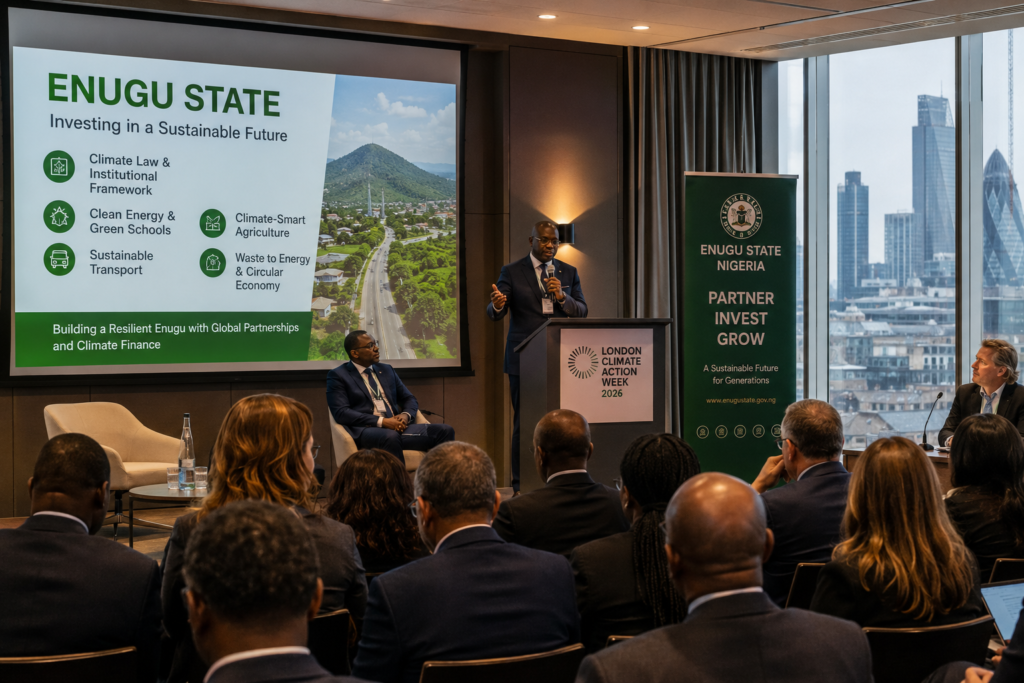
Enugu State showed up at the Nigeria Climate Investment Showcase during London Climate Action Week 2026 with something more specific than ambition. Prof. Chidiebere Onyia whom represented the Governor, Governor Peter Mbah made a direct pitch to global investors: Enugu is ready, the framework is in place, and the projects are real.
That is a harder thing to say credibly than it sounds. And Enugu has been working to back it up.
What Enugu Has Actually Built
Before making the pitch in London, Enugu spent time building the infrastructure that makes a pitch credible.
The state has enacted a climate law, it has established a Ministry of Environment and Climate Change. It has developed a Climate Change Policy and Action Plan. Clean transportation systems are in place. Urban greening initiatives are running. Smart green schools powered by rooftop solar are operating.
These are not announcements. They are implemented programmes. And that distinction matters enormously to the category of investor Enugu is trying to attract. International climate finance does not flow toward intention. It flows toward governance, documentation, and demonstrated delivery capacity. Enugu is building that track record deliberately.
The state has also developed a Climate Investment Plan that identifies specific projects, financing needs, and implementation responsibilities. Alongside this, a Climate Finance and Carbon Markets Unit is being established to manage investor engagement, project preparation, and climate finance tracking. These institutional pieces are exactly what development finance institutions and ESG-aligned funds require before committing capital.
What Is Actually on the Table
The sectors Enugu is presenting to investors are specific and connected to real development needs.
Waste-to-energy is one of the flagship opportunities. The proposed programme reduces methane emissions, improves waste management, generates electricity, produces compressed natural gas, and creates employment, all from the same intervention. That kind of multi-benefit project is exactly what climate finance instruments are designed to support.
Clean urban mobility is another priority. Electric buses, CNG transportation networks, charging infrastructure, and sustainable mobility corridors are all part of what Enugu is offering. For a city that has been growing steadily and attracting more investment activity, sustainable transport infrastructure is not a luxury. It is a requirement for managing that growth without locking in decades of carbon-intensive commuting patterns.
Climate-smart agriculture, green industrial zones, and clean cooking solutions complete the pipeline, each of these connects climate goals to livelihood outcomes , food security, rural income, women’s economic participation, employment creation. That connection between environmental and social impact is what the best climate finance instruments are increasingly structured to reward.
What This Means for Real Estate
Enugu’s climate investment strategy is not separate from its real estate story. It is the foundation of it.
Sustainable transport infrastructure increases the value of residential and commercial developments along its corridors. Reliable renewable energy reduces operating costs for every building connected to it. Green industrial zones attract the kind of economic activity that creates housing demand. Climate-resilient infrastructure reduces the flood and heat risk that is beginning to affect property values and insurance costs across Nigerian cities.
Developers and investors who are already positioning in Enugu’s growth corridors are building in an environment that is deliberately being shaped for climate-aligned investment. That is a different proposition from building in a market where climate infrastructure is absent and every project has to solve its own energy, transport, and resilience challenges from scratch.
The research showing that 78 percent of listed real estate companies globally now have carbon reduction targets is relevant here. That capital is actively looking for markets and projects that meet its criteria. Enugu is building the conditions to be one of those markets.
Real Estate Carbon Targets Nigeria: What 78% Means.
The Test Ahead
The pitch in London was strong. What comes next will determine whether it converts.
Climate finance is patient but not unconditional. Investors who commit to Enugu’s pipeline will be watching implementation timelines, governance standards, and the quality of project preparation with close attention. The Climate Finance and Carbon Markets Unit will need to function as advertised. The monitoring and reporting systems will need to produce data that meets international standards. And the projects themselves will need to deliver the environmental and economic outcomes that justified the investment.
If Enugu delivers on this, the implications go beyond the state. A Nigerian state government that successfully attracts and deploys international climate finance at scale with credible governance and measurable outcomes, becomes a model. It changes the conversation about what is possible for subnational climate investment across the continent.
That is the real prize on the table in London this week.
Conclusion
Enugu is not just pitching to investors, It is building the case, piece by piece, that it deserves to be taken seriously as a climate finance destination. The law is there, the ministry is there, the projects are named, the institutional infrastructure is forming. What happens next depends on execution, but the foundation being laid in Enugu right now is more substantial than most Nigerian states have managed to put together. The global climate finance community noticed, the real estate sector should too.
Smart Money Is Moving Into Nigerian Real Estate. Here Is Where It Is Going.
