
FG Proposes Licensing for Developers, Escrow Accounts to Protect Homebuyers
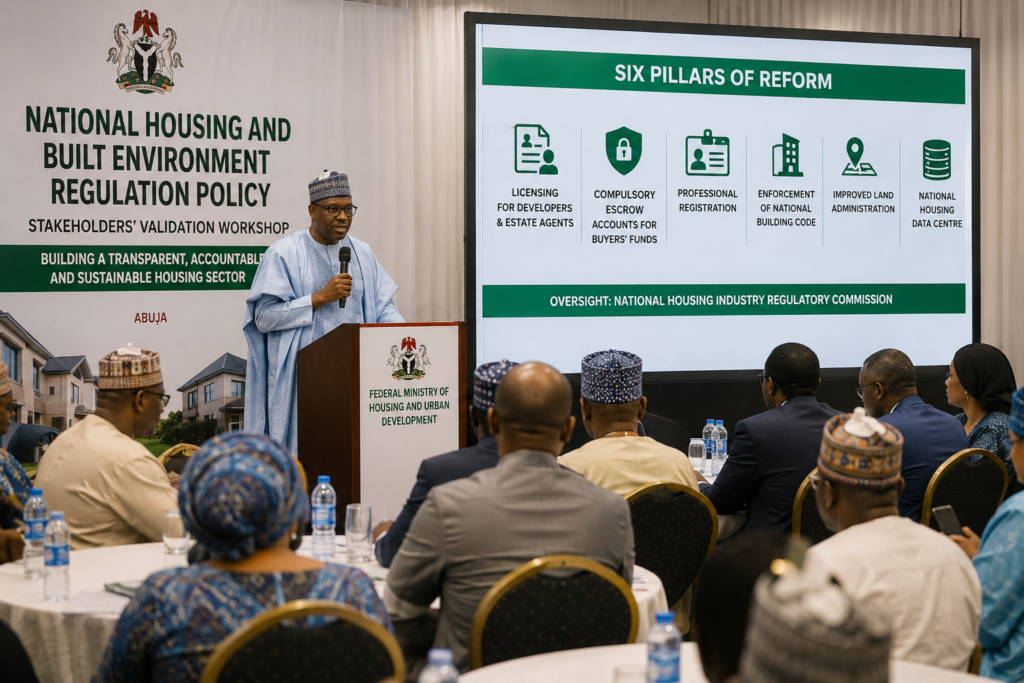
The Federal Government wants to overhaul how Nigeria’s housing sector operates. Minister of Housing and Urban Development, Dr. Muttaqha Rabe Darma, announced the plan at a stakeholders’ validation workshop in Abuja.
Six Pillars of Reform
Darma said the draft National Housing and Built Environment Regulation Policy rests on six pillars. These include licensing for developers and estate agents, compulsory escrow accounts for buyers’ funds, and professional registration. The policy also covers enforcement of the National Building Code, improved land administration, and a national housing data centre. A National Housing Industry Regulatory Commission would oversee the sector.
Why Now
Darma linked weak regulation to Nigeria’s recurring building collapses. He said many Nigerians have lost life savings to unlicensed developers operating without escrow protections. Real estate contributes about 13.4% of Nigeria’s GDP, roughly N41 trillion, and construction added over N77 trillion to the economy in 2025. Darma argued that scale demands stronger oversight, not less.
He pointed to Dubai as a model. Compulsory escrow accounts, introduced there in 2007, helped the emirate record over 270,000 property transactions worth about $250 billion in 2025.
Empty Houses, Rising Rents: The Paradox of Lagos Real Estate
Financing Alongside Regulation
Alongside the regulatory push, Darma stated that approximately six million Nigerians currently contribute to the National Housing Fund. The ministry is also developing a National Housing Finance Authority to expand mortgage access.
Darma acknowledged the reforms could face pushback from some stakeholders. He said government remains committed to the changes.
Why This Matters for Real Estate
Escrow protections and mandatory licensing would directly address two of Nigeria’s biggest homebuyer risks: losing money to unlicensed developers and buying into stalled or abandoned projects. If implemented well, the reforms could rebuild the kind of buyer confidence that has kept many Nigerians out of the formal property market.
Conclusion
Darma has laid out the framework. Whether it survives stakeholder pushback and reaches implementation will decide if Nigeria’s housing sector gets the credibility upgrade it needs.
Niger Flooding Real Estate Crisis: Lives Lost, Futures Drowned
PRAISE SAMSON