
Flood Risk Assessment In Property Investment: Why Lagos’s Warning Should Change How You Buy
Meta description: Flood risk property investment is now a key test for Nigerian buyers. See what Lagos’s flood warning means for your money and how to buy safely.
Focus Keyphrase: Flood risk property investment
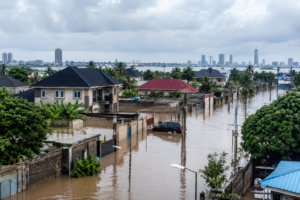
The Nigerian Meteorological Agency (NiMet) issued flash flood risk warnings for Lagos, Ogun, and 25 other states due to heavy rainfall and heavily saturated soils. Subsequently, the Lagos Mr. Tokunbo Philip Wahab has reiterated the seven-day flood warning, running from September 19 to 25 and probably beyond. Officials have asked people in low-lying and coastal areas to move to higher ground.
The warning names Eti-Osa, Lagos Island, Ajah and Kirikiri as vulnerable areas. Commissioner Tokunbo Wahab said no property is worth risking a life.
But here is the bigger story: this is not only about rain.
It is partly about the undeniable effects of non-climate change compliant development and its relationship with your money. Flood risk analysis in property investment is now one of the biggest questions any Nigerian buyer must answer, especially in flood prone locations.
For years, buyers treated floods as a seasonal nuisance. Yet the data says otherwise. Interestingly, a study of Lagos rainfall from 1983 to 2023 found that wet-season rain is getting more intense. Another 2026 study found that built-up land grew fast while forests and water bodies shrank.
So heavier rain now meets less open ground. Floods are the natural result. The question is no longer whether Lagos will flood. It is which properties will stay safe.
How Flood Risk Property Investment Affects Your Returns
So here is the gist. A beautiful house in the wrong place is still a weak asset. An estate with poor drainage becomes a liability. Buyers often discover these problems only after the first heavy rain.
Then the costs pile up. Repairs, lost rent and falling demand follow fast.
Clearly, climate risk is investment risk. Smart investors should weigh flood data as seriously as road access and market demand. Nigeria is also urbanising fast, which creates huge chances in housing and offices. However, buying without checking flood history can turn a good deal into a heavy loss.
Before You Buy That Property, Follow the Water
Smart Steps for Flood Risk Property Investment
The good news? You can protect yourself before you pay.
First, find out if the land floods. Talk to neighbours and check past records. Second, look at where stormwater goes. Blocked or missing drains are a red flag. Third, ask if the developer destroyed wetlands. Finally, use tools. Satellite images, GIS maps and flood-risk models can show safe zones before you sign. One Lagos study even used GeoAI to find flood-sensitive areas.
Government has to help too. Flood warnings should link to land-use rules, drainage spending and open development records, so buyers can see the risk before they commit.
Conclusion
Nigeria does not need to stop building, and investors do not need to stop buying. They need to buy smarter. The winners in African real estate will be those who understand flood risk property investment and choose assets that survive tomorrow’s rain.
How Climate Change Is Reshaping Property Insurance in Nigeria, And What It Means for Developers.