
Climate Risk Is Now a Deal Breaker in Global Real Estate. Nigeria Should Be Taking Notes.
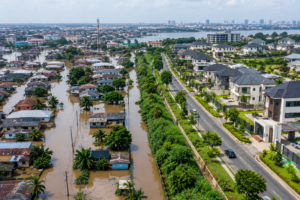
For years, climate risk in real estate was a future problem. Something to consider eventually. Something that would matter later.
Data released during Climate Week NYC confirms that later has arrived.
According to new industry studies released at the event, over 80 percent of property professionals now view climate risk assessments as just as critical as traditional structural and financial checks. Climate risk has moved from an environmental talking point to a core transactional due diligence requirement. The market has repriced. The question for Nigeria is whether the sector is paying attention.
The Value Map Is Being Redrawn
Coastal views and riverfront access commanded the highest premiums in real estate for decades. Extreme weather is reversing that trend.
Real estate models now indicate that what was historically called a 100-year flood carries roughly a 26 percent chance of occurring within a typical 30-year mortgage holding period. That single statistic is changing how lenders, insurers, and investors think about property in flood-prone locations globally.
The properties gaining value are those at higher elevations, with extensive tree canopy, resilient drainage systems, and master-planned infrastructure designed to manage extreme weather. The properties losing value are those in localised flood zones, grid-vulnerable areas, and locations where insurance is becoming unavailable.
Nigeria has communities in both categories. The sector has not yet drawn that line clearly.
Property Insurance Nigeria: How Climate Risk Is Repricing.
The Insurance Crisis Driving the Shift
The market shift is being accelerated by a climate insurance crisis playing out across multiple regions simultaneously.
Commercial insurers are adjusting underwriting guidelines, raising premiums sharply in climate-exposed areas, and in some markets withdrawing from vulnerable locations entirely. Because mortgage lenders require property insurance before approving capital, areas losing insurance coverage are seeing transactions stall before closing. Properties that cannot be insured cannot be financed. Properties that cannot be financed lose buyers. The value consequence follows.
Nigeria’s property insurance penetration is already low. The addition of climate risk repricing to an already thin insurance market creates a compounding vulnerability that the sector has not yet fully reckoned with.
What Developers Are Building Differently
To protect asset viability and maintain access to institutional capital, developers in more climate-aware markets are pivoting toward resilient design.
Nearly Zero Energy Buildings are incorporating fully electrified heating and cooling systems to reduce grid dependence. AI-optimised smart homes are using predictive energy systems that adjust automatically to localised weather patterns. Sponge-city engineering is designing communities with integrated drainage, tree-lined networks, and active ecosystem regeneration to absorb flash rainfall rather than redirect it into homes and roads.
These are not luxury features in markets where climate risk is priced into transactions. They are the baseline standard that determines whether a building retains its value, its insurance coverage, and its access to financing.
Sustainable Resilient Buildings Nigeria: Why Both Matter.
What This Means for Nigeria
The shift happening globally is not separate from Nigeria’s real estate reality. It is ahead of it.
Lagos floods every rainy season. Port Harcourt residents spend over 100 percent of their income on rent in part because climate-vulnerable housing stock is driving people toward fewer viable options. The 2026 flood outlook flagged over 14,000 Nigerian communities as high risk. Anambra communities are watching gullies expand toward their homes. Cross River displaced 347 people in a single week.
The global market is responding to these patterns by demanding climate resilience as a transaction requirement. Nigerian developers, investors, and lenders who build that requirement into their processes now are positioning ahead of a shift that is already underway. Those who wait are building assets that will face the same value contraction, insurance withdrawal, and financing difficulty that climate-exposed properties are already experiencing in other markets.
Location, location, location is no longer sufficient. In the current environment, the ultimate indicator of long-term property value has become resilience.
Conclusion
Climate Week NYC just confirmed what Nigeria’s rainy seasons have been demonstrating for years. Climate risk is not a future consideration. It is a present market reality. The global real estate sector has accepted that. The Nigerian sector needs to catch up before the gap between what institutional capital requires and what local developers offer becomes too wide to close.
Climate Ready Buildings Nigeria: Is Yours Built to Last?
PRAISE SAMSON