
Nigeria’s Climate Targets Are Ambitious. The Solutions Have to Come From Here.
Nigeria has set some of the most watched climate targets on the African continent. The numbers are significant. The ambition is real. But international experts are now asking a question that deserves more attention inside Nigeria than it has received: are the solutions being designed for Nigerian conditions, or borrowed from contexts that do not apply?
That question sits at the heart of a conversation the country needs to have urgently.
What Nigeria Has Actually Committed To
Nigeria’s climate commitments have grown more ambitious with each submission under the Paris Agreement. Under its NDC 3.0, unveiled at the United Nations General Assembly in September 2025, Nigeria pledged to reduce greenhouse gas emissions by 29% by 2030 and 32% by 2035, relative to 2018 levels, with a long-term target of net-zero emissions by 2060.
The sectoral targets are equally detailed. Mitigation priorities include cutting 60% of fugitive emissions from oil and gas, planting 25 million trees annually, reducing deforestation by 60%, scaling renewables to supply over half of Nigeria’s electricity by 2030, and expanding clean transport, with 30% of vehicles electric and 20% running on compressed natural gas by 2035.
These are not small commitments. On paper, they represent a genuine shift in direction.
The challenge is not the ambition. The challenge is the execution and specifically, whether execution plans reflect Nigerian realities or imported assumptions.
The Funding Gap Nobody Is Talking About Honestly
Nigeria’s climate targets come with a price tag that deserves direct conversation. Implementing the NDC requires an estimated $337 billion, with mitigation alone needing around $195 billion and adaptation requiring approximately $141.5 billion. Of that total, only 20% is expected to come from domestic sources, while 80% depends on international funding.
That ratio carries a risk that Nigeria cannot ignore.
When 80% of the financing for your climate plan sits outside your direct control, your ability to execute that plan depends on decisions made in Washington, Brussels, and Beijing. International climate finance has consistently fallen short of what developing countries were promised. Nigeria has experienced that gap directly. Between 2015 and 2021, Nigeria received just $4.93 billion in climate finance, mostly in concessional loans an amount far below the $270 billion in external financing the NDC 3.0 implementation requires.
Waiting for international funding to arrive before building local solutions is a strategy that has not worked. It needs to be rethought.
Why Local Solutions Are Not Optional
Climate change in Nigeria does not look the same as climate change in Germany or Canada. Flooding in Lagos displaces communities in ways that require housing and land tenure responses, not just drainage engineering. Desertification in the North pushes farmers southward and intensifies land use pressure in ways that generic reforestation programs cannot address alone. Extreme heat in urban centres like Abuja and Port Harcourt hits densely built informal settlements hardest, where building codes and green infrastructure standards barely exist.
These are Nigerian problems. They require Nigerian thinking.
That does not mean rejecting international expertise or ignoring global frameworks. It means using them as inputs rather than templates. A solar energy rollout designed around European grid infrastructure assumptions will fail in communities where the grid itself is absent or unreliable. A flood mitigation plan modelled on Dutch water management will miss the informal settlement dynamics that define how most Nigerian urban residents actually live.
Local solutions are not a compromise on ambition. They are the only version of ambition that actually works in this context.
Where Real Estate Sits in This Conversation
Nigeria’s built environment is one of the largest contributors to the country’s emissions trajectory and one of the least discussed in climate policy circles.
Buildings consume energy. Poorly designed buildings consume far more than necessary. Urban sprawl driven by unplanned development increases transport emissions and destroys green buffers that cities need. Construction materials, waste, and water use all carry carbon costs that Nigeria’s real estate sector has not yet been asked to account for seriously.
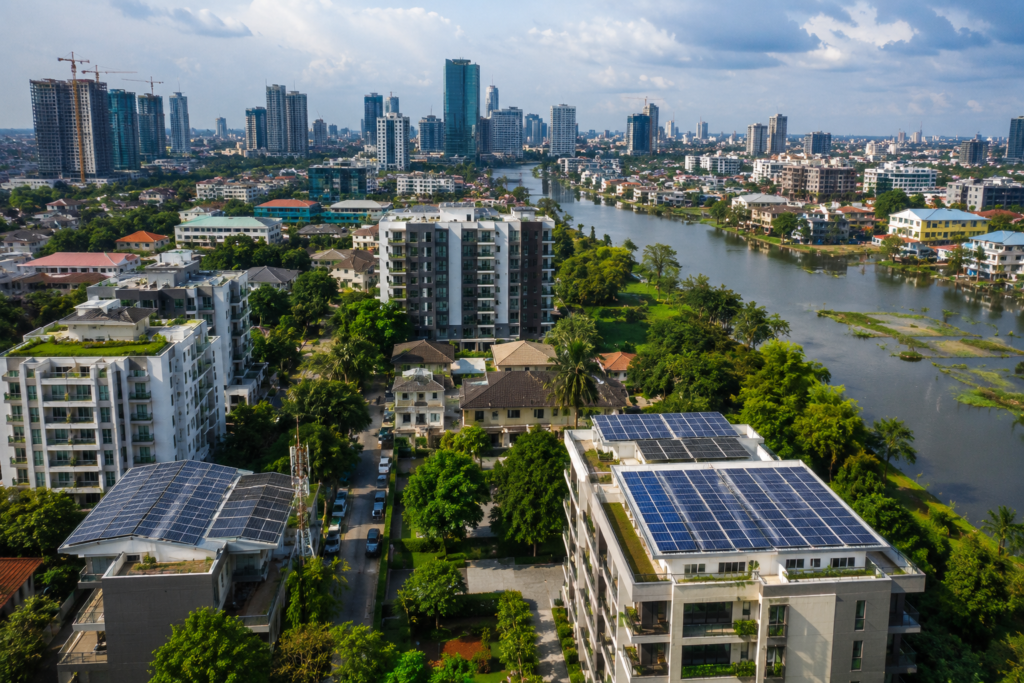
At the same time, the built environment offers some of the most accessible entry points for local climate action. Green building standards adapted to Nigerian materials and climate conditions. Urban planning frameworks that prioritise walkability and reduce car dependency. Land use policies that protect urban green spaces instead of converting them for short-term development gains.
These interventions do not require $270 billion from international donors. Many of them require policy decisions, regulatory frameworks, and developer standards that Nigerian institutions have the authority to implement today.
The Gap Between Policy and Practice
Nigeria has a Climate Change Act, passed in 2021. It has NDC commitments that international bodies have rated positively. It has a net-zero target for 2060 and a roadmap with sector-specific milestones.
What it does not yet have is a consistent bridge between those national commitments and what actually happens at the local government, developer, and community level.
Planting 25 million trees annually is a national target. The question is which communities plant them, on whose land, maintained by whom, and integrated into what broader land use plans. Cutting fugitive emissions from oil and gas by 60% is a sectoral target. The question is which regulatory mechanisms enforce it and what accountability exists when operators fall short.
Local solutions require local ownership. And local ownership requires that Nigerian institutions federal, state, and municipal treat climate commitments as operational mandates rather than diplomatic positions.
Conclusion
Nigeria’s climate ambitions are among the most detailed on the continent. The NDC 3.0 reflects genuine effort to set measurable, sector-specific targets across energy, transport, land use, and forestry.
But targets set in international negotiations only translate into real outcomes through decisions made at home. The communities most exposed to climate risk in Nigeria are not waiting for a global climate agreement to save them. They are adapting now, with or without a framework, using whatever local knowledge and resources they have.
The most useful thing Nigeria’s institutions can do is meet them there with policies, funding mechanisms, and regulatory frameworks designed for the country that actually exists, not the one that fits neatly into a global template.
Climate action rooted in Nigerian realities will always outperform climate action borrowed from somewhere else.