
Ghana’s Floods Displaced Nearly 90,000 People. Nigeria Should Be Paying Close Attention.
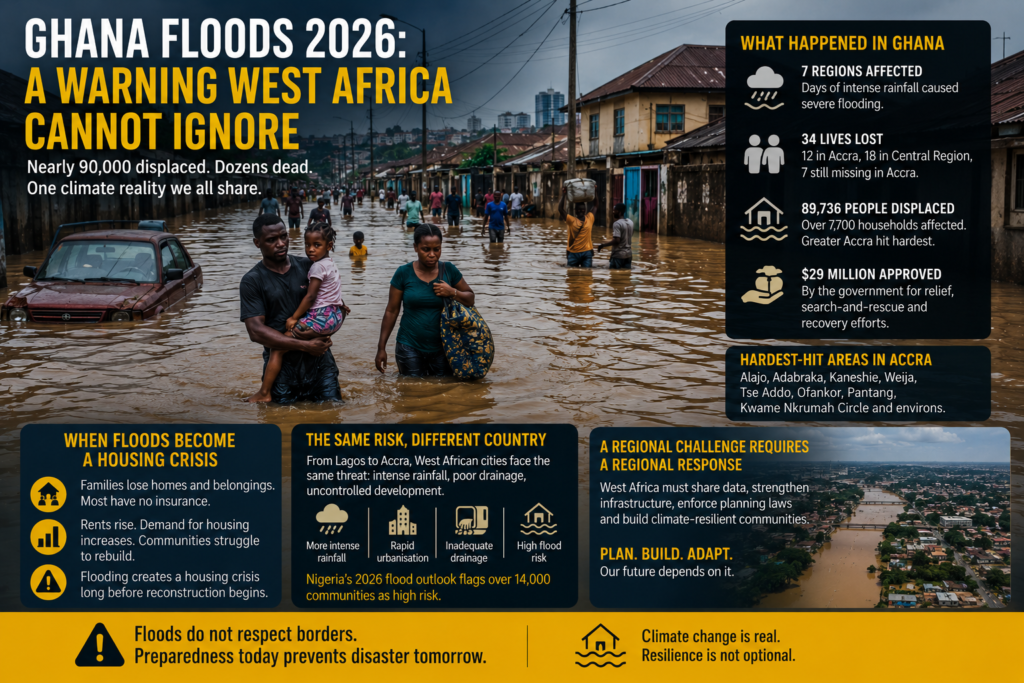
Floods no longer belong to one country.
When Accra floods, many Nigerians see it as Ghana’s problem. When Maiduguri floods, Ghanaians see it as Nigeria’s problem.
Climate change does not recognise those borders.
The flooding that swept across Ghana in late June and early July 2026 should concern Nigeria almost as much as it concerns Ghanaians. Not because the two countries share the same government, but because they increasingly share the same climate reality.
What Happened in Ghana
Days of intense rainfall triggered severe flooding across seven regions in Ghana, with Greater Accra and the Central Region hit hardest.
According to official figures, 34 people lost their lives. In Accra alone, 12 people died and seven remain missing. In the Central Region, 18 fatalities were recorded and multiple homes in Cape Coast collapsed entirely. Across the country, 89,736 people were displaced after floodwaters submerged homes, damaged roads, destroyed businesses, and cut off access to affected communities.
The hardest-hit areas in Accra included Alajo, Adabraka, Kaneshie, Weija, Tse Addo, Ofankor, Pantang, and the area around Kwame Nkrumah Circle. Over 38,000 individuals from more than 7,700 households fled the capital alone. Thousands more were displaced across the Volta, Western, Ashanti, Western North, and Eastern regions.
The National Disaster Management Organisation and the Ghana Armed Forces deployed rescue teams nationwide. Families were temporarily housed in school buildings and municipal offices. Emergency relief mattresses, food, maize, mosquito coils, was distributed while communities waited. The Ghanaian government has since approved approximately $29 million to support emergency relief, search-and-rescue operations, and recovery efforts.
Those numbers deserve to be read carefully. The biggest figure is not the death toll. It is the number of people who suddenly found themselves without a place to live. Nearly 90,000 people were displaced. That is the equivalent of an entire town losing its homes in a matter of days.
When Floods Become a Housing Crisis
When discussions around flooding begin, attention naturally focuses on rescue operations, casualties, and emergency relief. Those things matter. However, another crisis begins almost immediately afterwards.
Housing, Families whose homes are damaged must find somewhere else to stay. Some move in with relatives, others rent temporary accommodation, some remain in schools, churches, or emergency shelters for weeks. As a result, immediate pressure builds on local housing supply. Rents rise, vacant homes disappear quickly, entire communities are forced to rebuild from scratch while competing for already limited accommodation.
Flooding therefore creates a housing crisis long before reconstruction begins.
For the families displaced from Accra’s flooded communities, Alajo, Adabraka, Kaneshie, the challenge is compounded by the fact that most had no insurance coverage on their homes or belongings. When the waters recede, rebuilding depends on personal savings, family support, and whatever government relief reaches them. For many, that is not enough to rebuild to a standard that would survive the next flood.
Property Insurance Nigeria: How Climate Risk Is Repricing.
Ghana Floods Nigeria Warning: The Vulnerability We Share
The uncomfortable truth is that Nigeria faces many of the same structural risks Ghana is now confronting.
Large sections of Lagos remain highly vulnerable to flooding. Communities across Bayelsa, Rivers, Delta, Anambra, Kogi, Benue, and Niger States experience destructive floods almost every rainy season. In 2022, Nigeria experienced one of its worst flood disasters in decades, with more than a million people displaced and hundreds of communities affected.
Since then, climate projections have not become more encouraging. Rainfall is becoming more intense, storm events are becoming less predictable, urban development continues expanding into flood-prone areas. Yet construction practices have changed very little.
Nigeria’s 2026 flood outlook has already flagged over 14,000 communities across the country as high flood risk. The same structural vulnerabilities that turned heavy rainfall into a humanitarian crisis in Ghana, inadequate drainage, uncontrolled development on floodplains, housing stock built without climate resilience exist here at larger scale.
This Is Becoming a Real Estate Conversation
For years, flood risk was treated as an environmental issue. Today it is increasingly becoming a property issue.
Banks now consider location risk when evaluating long-term assets. Insurance companies are paying closer attention to climate exposure. Developers are beginning to recognise that buyers increasingly ask questions about drainage, elevation, and resilience before asking about finishes. That shift will continue.
Properties repeatedly exposed to flooding become more expensive to insure, harder to finance, and less attractive to investors. Clearly, climate risk is slowly becoming market risk. And market risk eventually shows up on balance sheets whether developers planned for it or not.
Building Back the Same Way Is No Longer Enough
Every major flood presents governments with a choice. Rebuild exactly what existed before. Or rebuild something capable of surviving the next storm. The second option costs more upfront. The first option costs far more over time.
Climate-resilient housing does not require futuristic technology. It requires stronger drainage systems. Better land-use planning. Construction standards that recognise today’s weather rather than yesterday’s climate. It also requires governments to stop approving developments on floodplains simply because demand for housing is high. Indeed, ignoring flood maps has become an expensive habit.
West Africa Needs to Think Regionally
One lesson from Ghana’s floods is becoming increasingly difficult to ignore. Climate disasters are no longer isolated national events. The same weather systems affecting Ghana often influence Nigeria, Benin, Togo, and Côte d’Ivoire. The same Atlantic storms. The same changing rainfall patterns. The same rising temperatures.
West African governments therefore need to exchange more than sympathy after disasters. They need to exchange planning models, flood forecasting systems, resilient construction standards, and adaptation strategies. Climate adaptation has become a regional challenge that no single country can solve from inside its own borders.
Conclusion
Ghana’s floods are a tragedy for the thousands of families whose homes disappeared beneath floodwaters. They are also a warning. Nearly 90,000 people displaced is not simply a humanitarian statistic. It is a reminder that housing remains one of climate change’s biggest casualties. Nigeria should not wait until another rainy season forces the same conversation at home. Every flood that happens elsewhere in West Africa is another opportunity to prepare before the next one arrives here.
West Africa Flooding Real Estate: Lagos and Accra Pay the Cost.