
Lagos to Dar es Salaam, melting ice far away is changing flood risk for coastal property here at home.
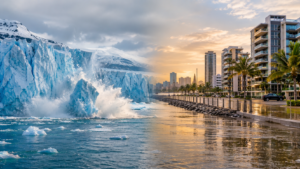
Most of us in property think about climate risk in terms of the next mortgage cycle or the next decade. A new report asks us to think much longer. Written by 80 scientists working with the International Cryosphere Climate Initiative and UNEP, and covered by The Guardian, it warns that overshooting the 1.5C warming target, even temporarily, could cause permanent damage to the world’s ice and snow.
Overshoot Is Not a Safe Plan B
The planet has already warmed by about 1.3C, and scientists now accept that some overshoot is likely. But the report pushes back on the idea that we can simply go past the target and fix things later. The ice sheets of Greenland and Antarctica are melting around six times faster than in the 1990s, and they would keep losing ice even if temperatures eventually came back down to 1.5C.
Current policies point to roughly 2.8C of warming. At that level, glacier mass in regions like the Alps and the Rockies would fall below 10%. A peak near 3C would thaw almost all near-surface permafrost and make severe disruption to ocean circulation likely. The authors say the truly safe limit for polar ice is closer to 1C.
Nigeria Nature-Smart Real Estate: Why Protecting Nature Makes Better Property Investments
Why This Lands in Real Estate
Melting ice is not a polar problem. It is a balance sheet problem. The report links ice loss to rising seas that threaten hundreds of millions of people, and to growing pressure on water security. For anyone developing or financing property near a coast, that means flood exposure, rising insurance costs, and assets that could be harder to sell in twenty years. Africa’s fast-growing coastal cities, from Lagos to Dar es Salaam, are firmly part of this conversation.
What Smart Developers Should Do Now
First, treat sea level and flood data as core due diligence, not an afterthought. Elevation, drainage, and site selection now shape what a property is worth.
Second, design for the long haul: raised foundations, flood-resilient materials, proper stormwater planning, and energy-efficient design that keeps a building’s own emissions down.
Third, bring climate risk into every conversation with lenders and buyers, because they are already asking.
A separate UNEP assessment says global emissions need to fall 18% by 2030 and 45% by 2035 to keep a good chance of limiting warming to 1.7C. Buildings are among the largest sources of energy-related emissions, so our industry has a real part to play.
The ice doesn’t negotiate. The projects we approve today will still be standing long after the COP31 talks in Turkey are forgotten. Let’s build like we know it.