
Nepal’s Deadliest Flood in Years Was Not Just a Natural Disaster. Climate Change Built the Conditions for It.
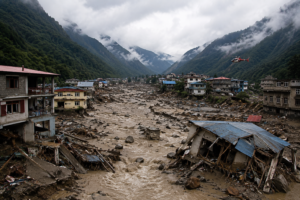
On the morning of 26 August 2026, a series of flash floods destroyed the Gyirong checkpoint on the China-Nepal border and tore through dozens of settlements along a 72-kilometre stretch of the Trishuli River in Nepal. At least 804 people are confirmed dead. More than 3,000 remain missing. Property damage is estimated at over $1.3 billion.
The precipitating event, according to investigators, was a glacier collapse on Langtang Lirung in the Himalayas, triggering a tremor detected by seismometers worldwide and sending a wall of water and debris through communities that had no time to evacuate.
This was not simply a natural disaster. The conditions that made it catastrophic have been building for decades.
What Climate Change Did Here
The Himalayas contain the largest concentration of glaciers outside the polar regions. Those glaciers are melting faster than at any point in recorded history. Rising global temperatures are destabilising ice formations that have been stable for centuries. When they collapse, they release stored water with devastating force into river systems and communities downstream.
According to climate scientists, glacial lake outburst floods are increasing in frequency and intensity across the Himalayas as temperatures rise. The communities most exposed are those with the least resources to relocate, rebuild, or recover.
Why This Matters Beyond Nepal
Nepal is not Nigeria. But the underlying dynamic is one that African cities including Lagos, Port Harcourt, and Accra are beginning to confront in their own context.
Climate change does not produce new categories of disaster. It takes existing vulnerabilities and amplifies them beyond what existing infrastructure and housing stock were designed to handle. The housing along the Trishuli River was built for the flood risk that existed historically. It was not built for what climate change is making that risk become. That gap between historical design standards and climate-adjusted reality is the same gap that leaves Nigerian communities exposed every rainy season.
Nigeria’s Flood Risk Real Estate 2026: What the Outlook Means.
The Built Environment Is Always Part of the Story
Every flood is partly a climate event and partly a built environment failure. For the real estate and construction sector, Nepal’s 2026 floods reinforce a point that applies as much in Lagos as in Kathmandu. Building to historical climate standards is no longer sufficient. The baseline has shifted. Infrastructure, housing, and urban planning need to account for the climate that is arriving, not the one that existed when the buildings were designed.
Property Insurance Nigeria: How Climate Risk Is Repricing.
Conclusion
804 people confirmed dead. More than 3,000 missing. $1.3 billion in property damage. Nepal’s 2026 flood is a tragedy of enormous scale. It is also a data point in a global pattern that is becoming impossible to ignore. Until the built environment catches up with climate reality, disasters like this will keep happening.
Climate Resilient Housing Nigeria: The Plateau State Warning.
PRAISE SAMSON