
Your Building May Be Standing, But Is It Climate-Ready?
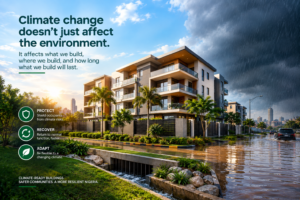
A building can pass every structural inspection, look impressive from the street, and still fail its occupants the moment conditions change.
That was one of the central arguments made by Nnamdi Arum at a recent climate and real estate session attended by Green Realty Africa. Arum framed climate change not as an environmental issue sitting separately from everyday life, but as a cross-sector reality already reshaping infrastructure, agriculture, transport, and the built environment simultaneously.
“Climate change is not just about the environment,” he said. “It affects what we build, where we build, and how long what we build will last.”
That framing matters for Nigeria’s real estate sector because it shifts the conversation from distant risk to present responsibility.
What the Sector Has Been Missing
The question most developers and buyers ask about a building is whether it will stand. The question that is increasingly urgent is whether it will keep functioning when conditions around it change.
Flooding in corridors that never flooded before. Temperatures pushing beyond what poorly ventilated spaces can manage. Power interruptions lasting days. Water supply disruptions in communities whose infrastructure was never designed for current demand levels. These are not hypothetical scenarios, they are happening across Nigerian cities right now.
Arum pointed to the way state policies, agricultural patterns, and community livelihoods are all being reshaped by climate shifts that most planning frameworks have not yet fully incorporated. The built environment is part of the same story.
Protect, Recover, Adapt
Engr. Onyekachi Darlington, who addressed the technical dimensions of building resilience at the same session, introduced a framework that gives developers and property owners a practical way to assess any building’s climate readiness.
The framework has three components. Protect; can the building shield its occupants from climate disruptions when they occur? Recover; how quickly can the building return to normal function after a disruption? Adapt; has the building been designed with the flexibility to respond to climate conditions that continue to shift over its lifespan?
Most Nigerian buildings, assessed honestly against those three questions, would not perform well. Not because they were poorly built, but because they were built for a climate that is no longer the climate they inhabit.
Why Location Changes Everything
Climate risk is not uniform across Nigeria. A developer building in Lagos faces flooding, coastal vulnerability, and urban heat as primary risks. Enugu’s terrain-driven flooding and rainfall intensity present a different profile. Kano’s extreme heat, dust storms, and increasingly unpredictable rainfall define yet another set of conditions.
A building designed without reference to its specific location’s climate reality is a building designed for a generic environment that does not exist. The materials, orientation, drainage, and ventilation should all reflect where the building actually sits.
What Developers and Buyers Should Start Asking
Before construction: What are the primary climate risks at this location? How does the design address flooding, extreme heat, and power disruption specifically? What happens to this building during a week without grid power or three days of heavy rainfall?
Before purchase: Has this property flooded before? How does stormwater leave the site? What backup systems exist? Has the drainage been designed for the rainfall volumes this location actually receives?
These questions are not reserved for engineers, they are the basic due diligence that protects any investment from the climate it will actually face.
Property Insurance Nigeria: How Climate Risk Is Repricing.
Conclusion
A building should not only be designed to stand. It should be designed to keep functioning when conditions change. Nigeria’s climate is already changing. The buildings going up today will still be standing in 2060. Whether they serve their occupants well or fail them at the worst possible moments depends on decisions being made right now.
Extreme Heat Nigeria Real Estate: Buildings Are Not Ready.
Praise Samson