Real Estate, Roads, and Climate Change: What Enugu’s Director of Climate Change Wants Developers to Know
When Green Realty Africa visited the Enugu State Ministry of Environment and Climate Change recently, the conversation inevitably turned to real estate. What the Director of Climate Change, Dr. Arum Nnamdi said should concern every developer operating in Nigeria today.
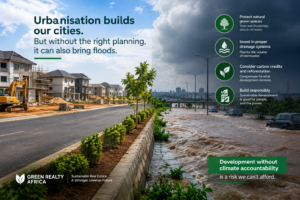
“It is a problem,” he said, when asked about the intersection between urbanisation and climate change. “We must develop, we must construct roads, build houses, but when you create an access road, trees and shrubs must go. When you pave that road, you deny water percolation. The water becomes runoff and that runoff causes flash floods.”
The Hidden Cost of Development
Dr. Nnamdi described what happens when a developer opens an estate. A road is built, trees are cleared, the land is paved. Every paved surface eliminates the natural absorption that once slowed rainwater. The water moves faster, accumulates in channels, and overwhelms drainage systems that were never designed for the volume.
This is not hypothetical, It is what is happening in Nigerian cities right now. Lagos, Port Harcourt, and increasingly Enugu are experiencing floods that are partly the result of development decisions made without accounting for stormwater.
“The earth is just a small place,” Dr. Nnamdi said. “All of us are parasitic. We are tiny things on earth. We won’t understand that all those natural processes are closed when natural variabilities are disrupted.”
What Compensation Looks Like
Dr. Nnamdi pointed to carbon credits, Paris Agreement commitments, and green building standards as the tools that exist to compensate for what development removes. The obligation, he said, is not to stop building. It is to build with accountability.
Developers who pave land for estates should be thinking about what stormwater infrastructure replaces the absorption they have eliminated. Those who clear trees should be considering what reforestation or carbon offset mechanism compensates for that loss. These are not luxury considerations, they are structural requirements for responsible development.
“Anything you are solving is not just for Enugu State,” he said, “It is for the world.”
Nigeria’s Flood Risk Real Estate 2026: What the Outlook Means.
Nigeria’s 2026 Flood Outlook Is Out. The Real Estate Sector Needs to Read It.
Conclusion
Enugu’s Director of Climate Change is not anti-development, He is pro-accountability. The sector needs more conversations like the one Green Realty Africa had in that ministry office. Not because they are comfortable. But because they are necessary.
Why Lagos Demolished 17 Ikota Homes: What Every Buyer Must Know
PRAISE SAMSON