
Enugu’s Waste-to-Energy Plan: What the Director of Climate Change Says
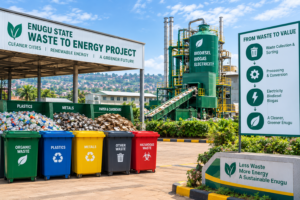
One of the most ambitious programmes currently being developed in Enugu State has nothing to do with solar panels or carbon credits. It starts with waste.
Dr. Arum Nnamdi, Director of Climate Change at Enugu’s Ministry of Environment and Climate Change, informed Green Realty Africa during a recent visit that the state is actively developing a waste-to-energy initiative aimed at converting municipal waste into electricity, biodiesel, and biogas.
The state recently convened a working group at the Old Governor’s Lodge, bringing together the commissioner, senior government officials, and technical experts to map out how this would work in practice.
Why the Technology Question Matters
Dr. Nnamdi was clear about what will determine whether the programme succeeds or fails.
“You need to know what you are generating, whether your waste will power what you want to power, and whether you have the technology to separate those wastes,” he said. “If you gather all the waste and mix them together without the right technology, the whole place will crash.”
Waste separation is the critical first step. Organic waste with high calorific value cannot be mixed with low-value materials. Hospital waste requires entirely separate handling. Oil-based waste cannot be combined with organic matter.
The department is working with PACE, an NGO, and other partners to collect weighbridge data and calorific value assessments from key Enugu markets including New Market and Soca, to understand exactly what the city generates before designing the system around it.
The Hidden Cost of Poor Waste Management on Nigerian Real Estate Values.
The Communication Challenge
Dr. Nnamdi also raised a challenge that goes beyond technology. Getting residents to sort their waste at home remains difficult.
“Youths don’t listen to the normal radio station,” he said. “When they have their phone it is either TikTok whatsapp, Instagram or YouTube. When you end the music and say now we are going to talk about the environment, only the elderly may listen.”
His household, he said, already sorts waste. Bottles go in one place, sachets in another, diapers separately. The system works when people understand why it matters. Getting that message to scale is the next challenge.
Conclusion
Enugu’s waste-to-energy ambition is real. The working groups exist, the data collection is underway, the technology questions are being asked before commitments are made. That careful, grounded approach is what separates a credible programme from an announcement. Green Realty Africa will continue following this story.
PRAISE SAMSON