
Abia State Is Trying to Fix Nigeria’s Housing Trust Problem. Here Is What the Bills Say.
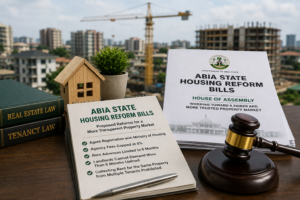
Nigeria’s property market has a trust problem that goes deeper than most people acknowledge. Fraudulent listings, double-commissioning, opaque tenancy terms, and recurring landlord-tenant disputes have made many Nigerians wary of investing in housing and held back private capital that could help close the country’s housing gap.
Abia State is trying to change that.
The Abia State House of Assembly has moved forward with two housing reform bills. The first, sponsored by Hon. Egwuronu Mandela Obasi of Ohafia North, has passed its first reading. The second, introduced by Deputy Speaker Austin Okezie Meregini of Umuahia East, has cleared its second reading. Both bills are still working through the legislative process and have not yet become law.
What the Bills Are Proposing
If approved, all property agents in Abia would be required to register with the Ministry of Housing. Agency fees would be capped at five percent, rent advances limited to six months, and landlords prohibited from demanding more than six months upfront. Collecting rent for the same property from multiple tenants would also be banned.
These are practical, measurable commitments that address the specific practices making renting in Nigeria so financially punishing for tenants and so reputationally damaging for the sector as a whole.
Nigeria’s Rental Crisis Is Getting Worse. Nobody Is Talking About It Enough.
Why This Matters Beyond Abia
Trust is not a soft concept in real estate. It is a market condition. A market where agents operate without accountability and tenants can be defrauded prices risk higher than it needs to be. If Abia’s bills pass and are enforced consistently, the state could demonstrate something the rest of Nigeria’s housing sector needs to see — that regulation does not slow down a market, it makes the market work better for everyone inside it.
The Test Is Always Enforcement
Bills become law. Laws become policy. Policy becomes practice only when enforcement follows. Nigeria has housing legislation that has not yielded the expected outcomes because the gap between what is written and what is implemented remains substantial. Whether Abia builds the institutional capacity to enforce these specific commitments is what will determine whether this reform becomes a model or another announcement.
Lagos Is Going After Fraudulent Estate Agents. The Real Estate Sector Should Welcome It.
Conclusion
Abia’s proposed housing bills are not yet law. But the conversation they represent is one Nigeria’s property market needs urgently. The sector should be watching Abia closely.
The FCCPC Just Sealed Two Abuja Real Estate Firms. The Sector Should Pay Attention.
PRAISE SAMSON